Notice: Function _load_textdomain_just_in_time was called incorrectly. Translation loading for the debug-bar domain was triggered too early. This is usually an indicator for some code in the plugin or theme running too early. Translations should be loaded at the init action or later. Please see Debugging in WordPress for more information. (This message was added in version 6.7.0.) in /home4/birdfind/public_html/wp-includes/functions.php on line 6131

Notice: Function _load_textdomain_just_in_time was called incorrectly. Translation loading for the ht-easy-ga4 domain was triggered too early. This is usually an indicator for some code in the plugin or theme running too early. Translations should be loaded at the init action or later. Please see Debugging in WordPress for more information. (This message was added in version 6.7.0.) in /home4/birdfind/public_html/wp-includes/functions.php on line 6131

Warning: Cannot modify header information - headers already sent by (output started at /home4/birdfind/public_html/wp-includes/functions.php:6131) in /home4/birdfind/public_html/wp-includes/feed-rss2.php on line 8
birdfinding.info https://birdfinding.info Birds and Travel Wed, 21 Aug 2024 18:06:54 +0000 en-US hourly 1 https://wordpress.org/?v=6.9.4 Thick-billed Longspur https://birdfinding.info/thick-billed-longspur/ https://birdfinding.info/thick-billed-longspur/#comments Wed, 07 Aug 2024 10:54:07 +0000 https://birdfinding.info/?p=139595

Birdfinding.info ⇒  Uncommon, localized, and seldom seen without a dedicated effort.  Locally common on some parts of its breeding grounds, which are a small remnant of their historical extent.  Accessible locations with robust breeding populations include: the western sector of the Pawnee National Grassland in Colorado; Sand Creek Road (southwest of Laramie), Wyoming; the Wheatland-Harlowton area in south-central Montana; the Trans-Canada Highway northwest of Suffield, Alberta; and the Onefour area of southeasternmost Alberta and adjacent Saskatchewan.  In winter, large flocks occur in barren plains of the Texas Panhandle and adjacent areas: e.g., Hansford County (north of Amarillo) and Lubbock Airport.  In southcentral Texas, regular wintering sites include Granger Lake (northeast of Austin) and Knippa (east of Uvalde).  In southeastern Arizona, Kansas Settlement in the Sulphur Springs Valley south of Willcox has been a consistent site.

Thick-billed Longspur

Rhynchophanes mccownii

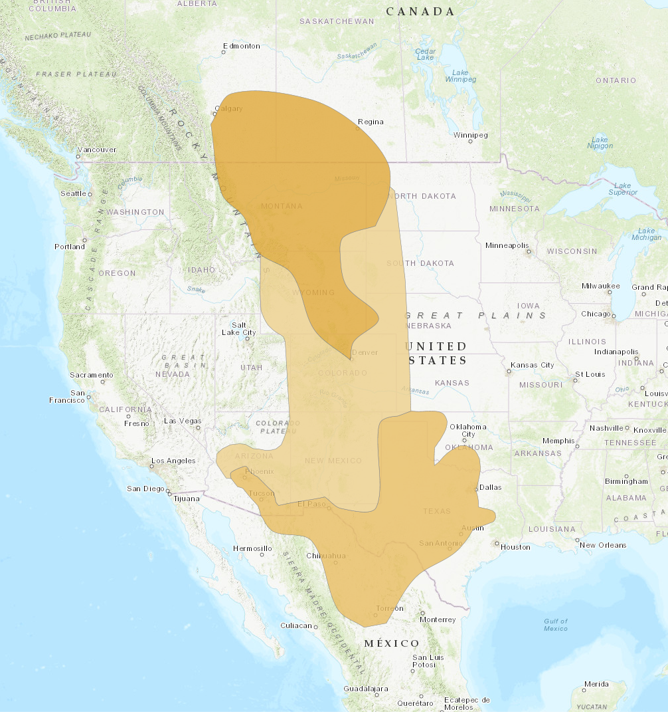
Breeds on the high plains from Alberta to Colorado; winters in the southwestern U.S. and north-central Mexico.

Approximate distribution of the Thick-billed Longspur.  © BirdLife International 2021

Breeding.  Breeds in open short-grass prairies from southeastern Alberta and southwestern Saskatchewan south through Montana, northern and eastern Wyoming, and western Nebraska to central-eastern Colorado.  Mainly east of the Rocky Mountains, but extends into intermontane valleys of Montana northwest of the Yellowstone uplift.  Formerly bred farther east into North Dakota and South Dakota, where a few breeding sites remain active along the western borders of both states.

Nonbreeding.  Winters mainly on large, flat expanses of barren open ground, such as dry lakebeds.  Winter range extends from eastern Colorado and western Kansas south through southern and eastern New Mexico, southern Arizona, western Oklahoma, western and central Texas, and the central plateau of Mexico south to northern Durango.  Small numbers regularly winter west of the usual range, from the Great Basin of Utah and Nevada to southern California and western Arizona.

Breeding Bird Survey Abundance Map: Thick-billed Longspur.  U.S. Geological Survey 2015

Movements.  Spring migration is relatively early and brief, from mid-March to mid-April.  Southbound migration spans from August into October.

Casual as a fall and winter vagrant west to southern Oregon and northern and central California.  More exceptional in the Pacific Northwest and the southeastern U.S.  There is a single winter record from Massachusetts.

Spring vagrants are occasionally found east of the breeding range, exceptionally to the Great Lakes (with three May records from the southern shore of Lake Superior), and at scattered locations in western and central Canada, including the interior of British Columbia, the southern Yukon (Watson Lake; June 16, 2022), north-central Manitoba, and northwestern Ontario.

Identification

The Thick-billed Longspur’s tail pattern—mostly white with a dark inverted T—is diagnostic in all plumages.  The male’s breeding plumage is striking and instantly recognizable.  Other plumages are mostly plain and nondescript, apart from their unique tail pattern.  At rest, its wings often droop down along its flanks, exposing the rump.

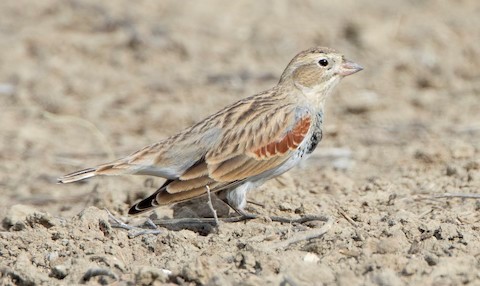
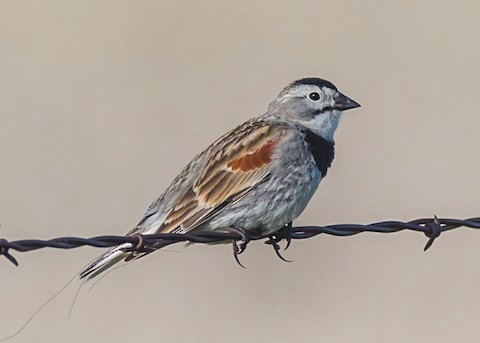
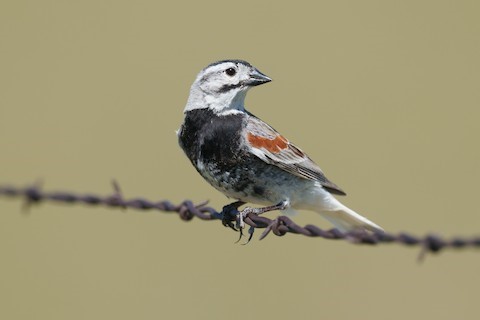
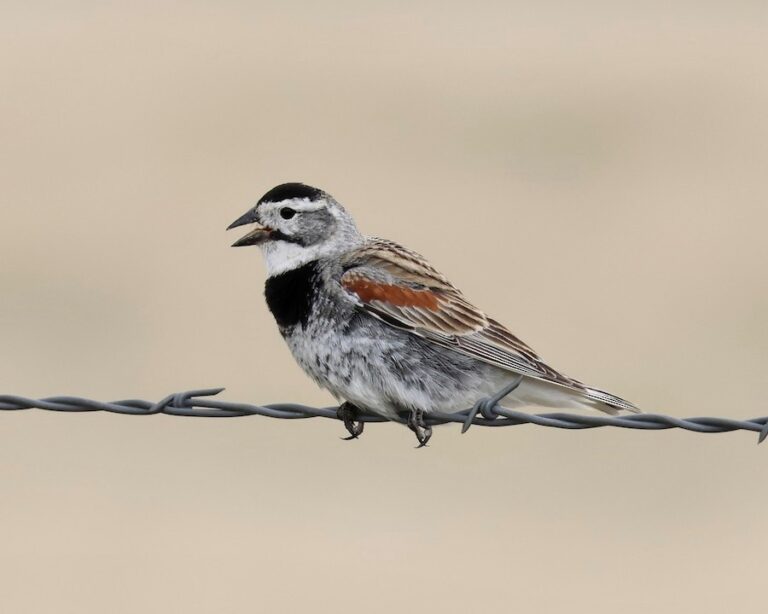
Thick-billed Longspur, male in breeding plumage, with tail folded but still showing mostly white tail feathers.  (Pawnee National Grassland, Weld County, Colorado; May 5, 2016.)  © Phillip Edwards

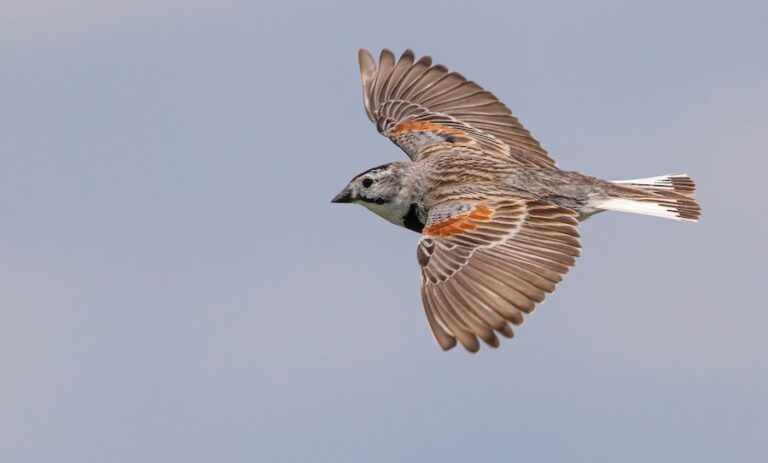
Males in breeding plumage are mostly gray with a black crown, white face and throat, black malar stripe, black bib, black bill, and a bold rufous wingbar.  The upperparts are tan-brown and heavily streaked.

Nonbreeding males typically show a muted version of the breeding plumage, with indistinct brown-and-tan facial markings and a mostly pink bill that often has a blackish tip.  The upperparts and bold rufous wingbar remain essentially the same as in breeding plumage.  The underparts are mostly gray, usually with some black on the chest.

Thick-billed Longspur, male in nonbreeding plumage showing characteristic droop-wing posture.  (Perris, California; December 6, 2015.)  © Mark Chappell

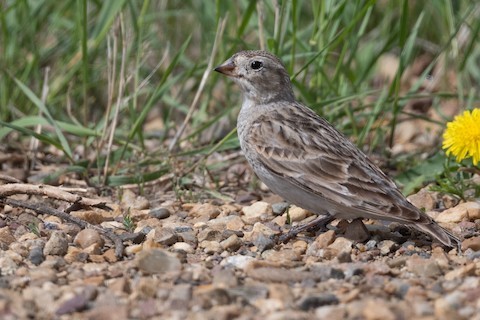
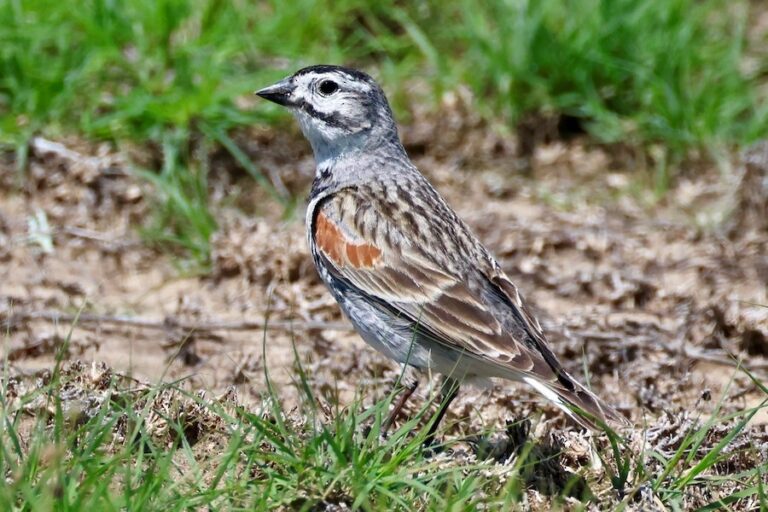
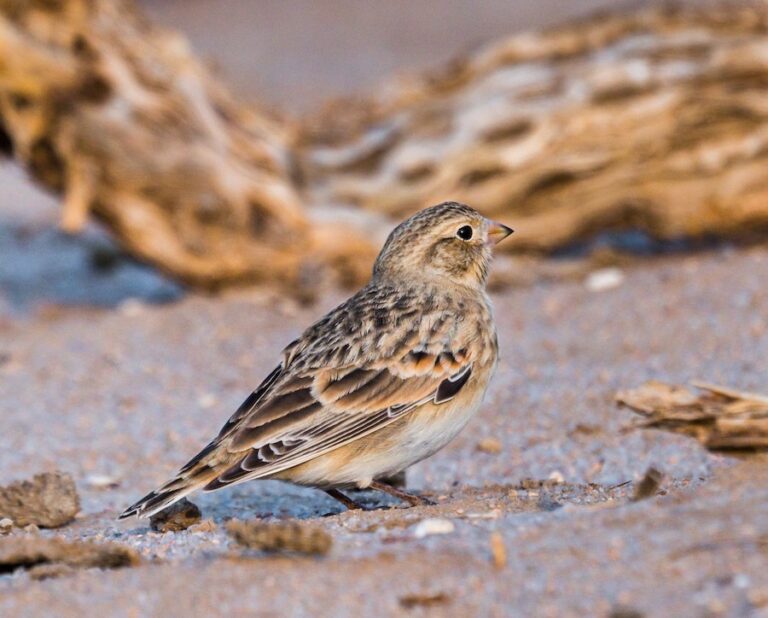
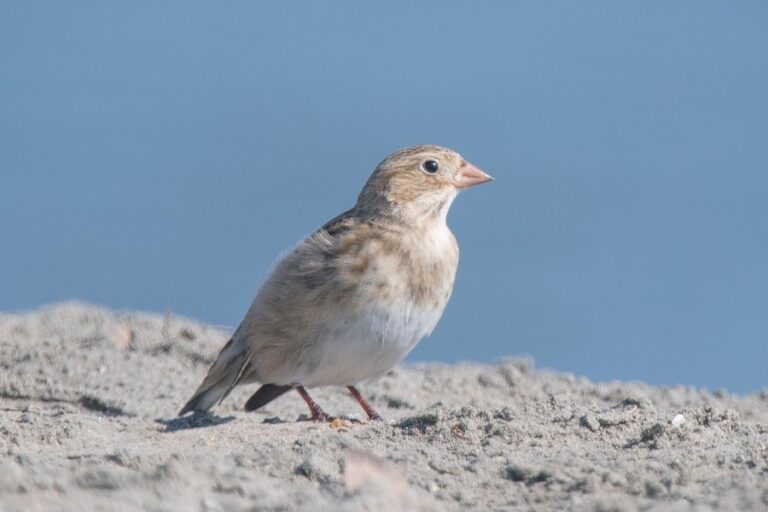
Females and immatures are brown and streaked above and pale-gray below, with a mostly pinkish (often black-tipped) bill and a washed-out, indistinct head pattern.  They sometimes show subtle blackish smudges on the chest, but are usually unstreaked below—unlike other female and immature longspurs.

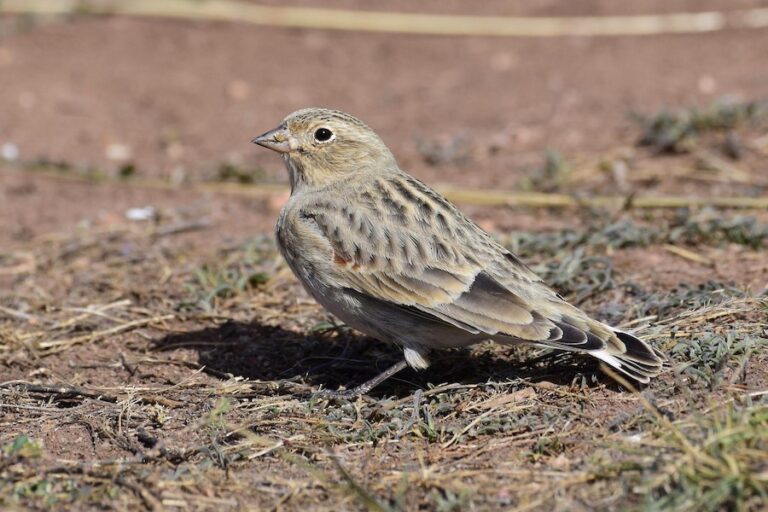
Thick-billed Longspur, female showing plain gray-and-brown plumage—note the thick appearance of the bill, which appears mostly blackish in the breeding season.  (Rock Creek Trail, Grasslands National Park, Saskatchewan; May 15, 2024.)  © Amanda Guercio

Thick-billed Longspur, female showing streaked brown upperparts—with the tail folded, the dark central tail-feathers completely conceal the distinctive pattern.  (Fiesta Island, San Diego, California; March 18, 2021.)  © Patrick Sysiong

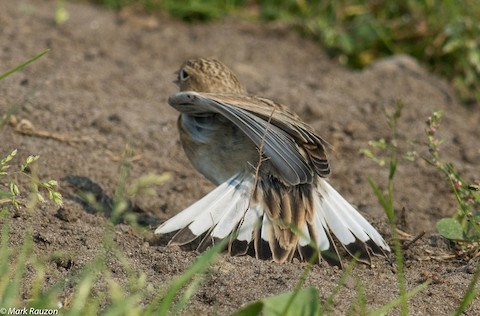
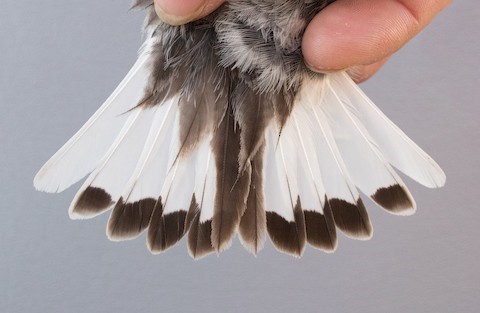
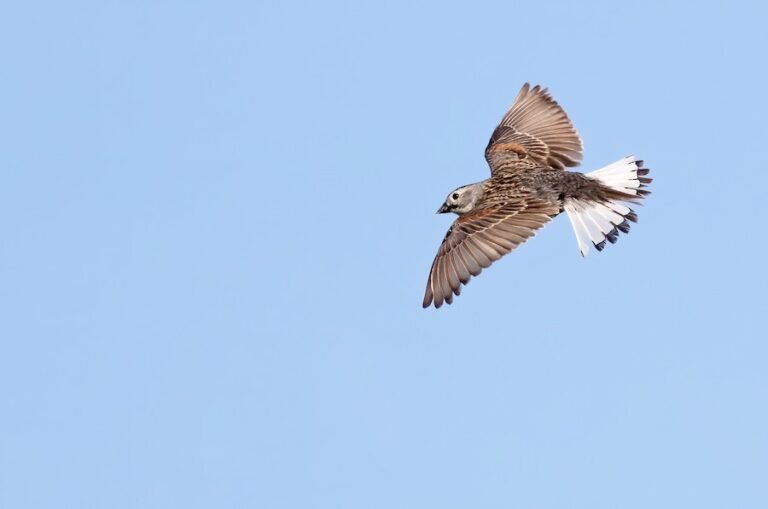
The “inverted T” tail pattern is distinctive, but not readily detectable when the tail is folded.  When spread, the tail is mostly white except for the two central feathers, which are brown.  The outermost feathers are all-white, or nearly so.  The rest of the tail-feathers are white with black tips.

Thick-billed Longspur, immature male with tail fully fanned out, showing the distinctive “inverted T” tail pattern with brown central tail feathers and black terminal band on otherwise all-white feathers.  (Crissy Field, Presidio, San Francisco, California; October 12, 2017.)  © Mark Rauzon

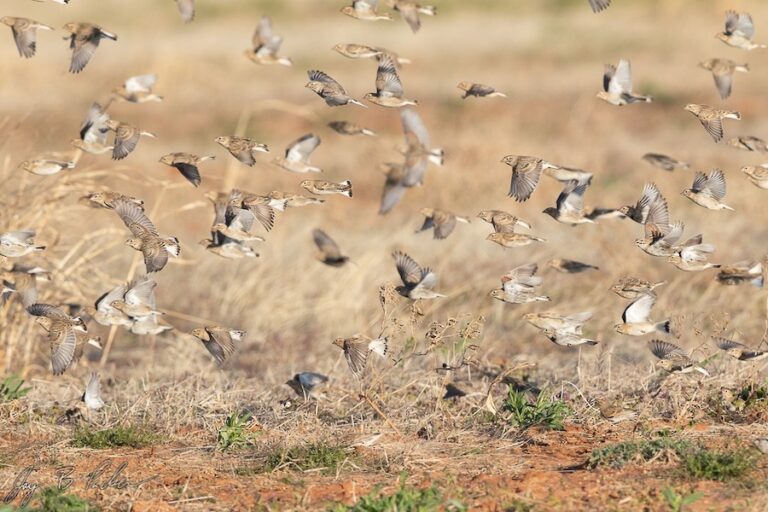
Thick-billed Longspur flock in flight, with several individuals showing the distinctive “inverted T” tail pattern.  (Merkel, Texas; March 4, 2019.)  © Jay Packer

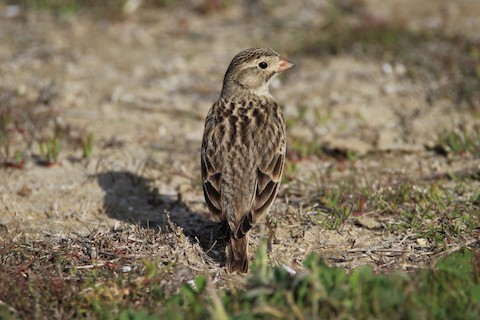
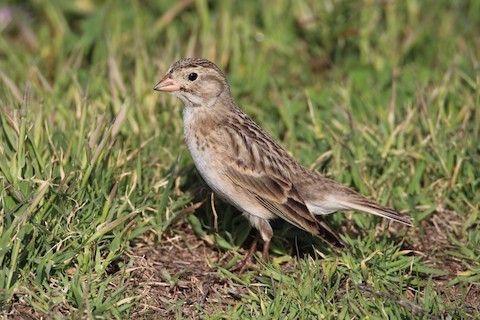
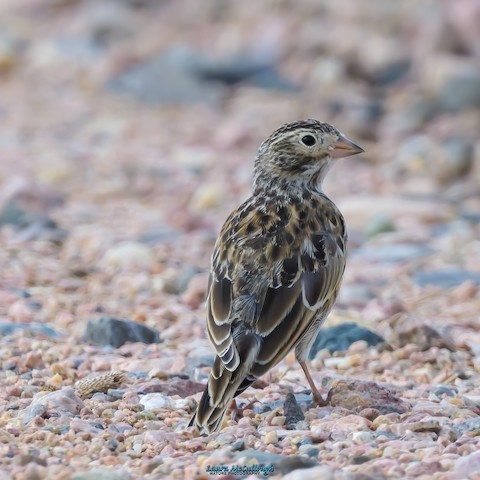
Juveniles are heavily streaked above and partly streaked below.  Older immature plumages resemble adult females: conspicuously streaked above, but nondescript except for the tail pattern.

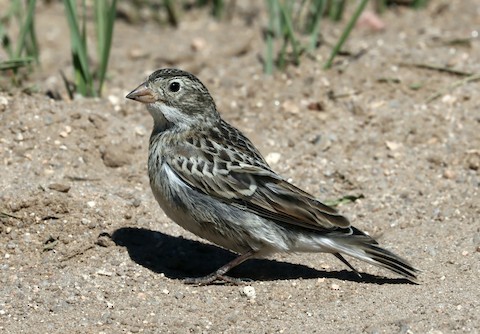
Thick-billed Longspur, immature showing overall nondescript appearance, with a sliver of its tail pattern and a tiny rufous patch visible on the wing.  (Manitou Lake, Colorado; October 12, 2019.)  © David de Rivera Tønnessen

Thick-billed Longspur, juvenile.  (Calhan, Colorado; June 25, 2023.)  © John Drummond

Voice.  Song consists of musical, liquid warbling, with variable phrasing:Sometimes sings in brief warbles that resemble songs of the American Robin:Common flight call is short rattle that is typically softer and shorter than the similar calls of other longspurs:Also gives a sharp pink! call, which is often combined with rattle calls:

Notes

Monotypic species and genus.

The Thick-billed Longspur owns the dubious distinction of being the first bird species whose original English name was changed because it memorialized an individual whose legacy of race-based oppression of other humans was adjudged to be so offensive as to merit erasure from the ornithological nomenclature.  John Porter McCown (August 19, 1815 – January 22, 1879) was a general in the Confederate Army who renounced his commission in the U.S. Army and fought to perpetuate slavery.  He was also a birdwatcher who published a paper on the Greater Roadrunner (Geococcyx californianus) and collected the type specimens of three species, including one that was named in his honor: Rhynchophanes mccownii.  In 2020, the American Ornithological Society formally changed the English name from McCown’s Longspur to Thick-billed Longspur.

More Images of the Thick-billed Longspur

Thick-billed Longspur, male in breeding plumage.  (Mission Lake, Montana; May 14, 2016.)  © BJ Worth

Thick-billed Longspur, male in breeding plumage.  (Harlowton, Montana; June 13, 2024.)  © Jeff Hapeman

Thick-billed Longspur, male in breeding plumage.  (Pawnee National Grassland, Weld County, Colorado; June 13, 2023.)  © Phil Lehman

Thick-billed Longspur, male in breeding plumage with tail fully fanned out, showing inverted T pattern—white with dark central feathers and a narrow black terminal band.  (Sage Creek Provincial Grazing Reserve, Bain, Alberta; June 28, 2023.)  © Nicole Richardson

Thick-billed Longspur, male in breeding plumage with tail fully fanned out, showing inverted T pattern—white with dark central feathers and a narrow black terminal band.  (Range Road 105, Ralston, Alberta; June 9, 2020.)  © Joachim Bertrands

Thick-billed Longspur, male in breeding plumage with tail partly spread, showing a dark triangle—in this posture, reminiscent of Chestnut-collared Longspur’s tail pattern.  (Pawnee National Grassland, Weld County, Colorado; June 13, 2023.)  © George Armistead / Hillstar Nature

Thick-billed Longspur, female with wings drooped down in somewhat characteristic posture.  (Fiesta Island, San Diego, California; March 18, 2021.)  © Patrick Sysiong

Thick-billed Longspur, juvenile.  (Pawnee National Grassland, Weld County, Colorado; August 20, 2023.)  © Laura McCullough

Thick-billed Longspur, immature.  (Chico Basin Ranch, El Paso County, Colorado; September 19, 2020.)  © Jim Merritt

Thick-billed Longspur, female—a pale individual.  (Crown Point, San Diego, California; November 6, 2018.)  © Nancy Christensen

References

Alderfer, J., and J.L. Dunn. 2021. National Geographic Complete Birds of North America (Third Edition). National Geographic Society, Washington, D.C.

BirdLife International. 2021. Rhynchophanes mccownii. The IUCN Red List of Threatened Species 2021: e.T22721025A137367734. https://dx.doi.org/10.2305/IUCN.UK.2021-3.RLTS.T22721025A137367734.en. (Accessed July 29, 2024.)

eBird. 2024. eBird: An online database of bird distribution and abundance. Cornell Lab of Ornithology, Ithaca, N.Y. http://www.ebird.org. (Accessed July 29, 2024.)

Howell, S.N.G., and S. Webb. 1995. A Guide to the Birds of Mexico and Northern Central America. Oxford University Press.

Salt, W.R., and J.R. Salt. 1976. The Birds of Alberta. Hurtig Publishers, Edmonton, Alberta.

Sibley, D.A. 2014. The Sibley Guide to Birds (Second Edition). Alfred A. Knopf. New York.

Wikipedia. 2024. John P. McCown. https://en.wikipedia.org/wiki/John_P._McCown. (Accessed July 29, 2024.)

Xeno-Canto. 2024. Thick-billed Longspur – Rhynchophanes mccownii. https://xeno-canto.org/species/Rhynchophanes-mccownii. (Accessed July 29, 2024.)

]]>
https://birdfinding.info/thick-billed-longspur/feed/ 1
McKay’s Bunting https://birdfinding.info/mckays-bunting/ https://birdfinding.info/mckays-bunting/#comments Tue, 09 Jul 2024 12:37:43 +0000 https://birdfinding.info/?p=139361

Birdfinding.info ⇒  Due to the remoteness of its range, this Alaskan endemic is among the least-observed North American birds.  Its usual breeding range comprises two uninhabited offshore islands, St. Matthew and Hall, that rarely appear on tour itineraries.  It has been found fairly regularly at Gambell in spring, summer, and fall, and likely occurs year-round on St. Lawrence Island (which is very large and little-explored).  It has also been recorded sporadically on St. Paul Island.  The most accessible site where it can be found reliably is Nome, where it occurs from October to April.  Since the early 2010s, small numbers have been found annually in winter on the Kenai Flats.

McKay’s Bunting

Plectrophenax hyperboreus

Endemic to Alaska: breeds on St. Matthew and Hall Islands in the northern Bering Sea.  The global population has been estimated in the range of 27,500 to 35,400 (Matsuoka and Johnson 2008).

Small numbers also occur in summer on St. Lawrence Island and irregularly on St. Paul Island.  There are nesting records from both islands.

Winters mainly along the western coast of Alaska from the Kotzebue area south to the Alaska Peninsula, and on Nunivak Island.  Small numbers have recently been found wintering in south-coastal Alaska: most regularly on the Kenai Peninsula; more occasionally around Anchorage and on Kodiak Island—the distribution of records corresponds to winter observer coverage, so it presumably occurs more widely and regularly in unpopulated areas of south-coastal Alaska but goes undetected.

Casual in winter along the Pacific coast from southeastern Alaska south to Oregon.  One summer vagrant has been recorded along the Beaufort Sea coast of the Yukon Territory (Herschel Island, July 2005).  Has also been recorded from the Chukchi Peninsula, where it presumably occurs regularly.

Identification

McKay’s Bunting is likely to be confused only with its much more numerous and widespread relative, the Snow Bunting, which occurs throughout McKay’s’ small, remote Alaskan range.  The adult male McKay’s is distinctive year-round, whereas female and first-winter McKay’s can be extremely similar to Snows.  (See detailed comparison below.)

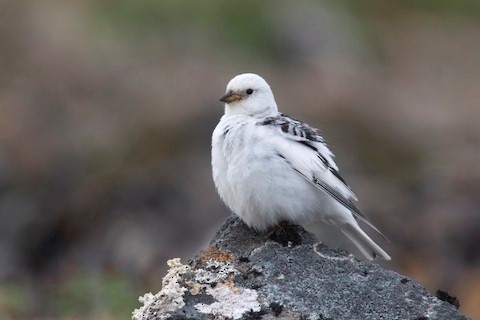
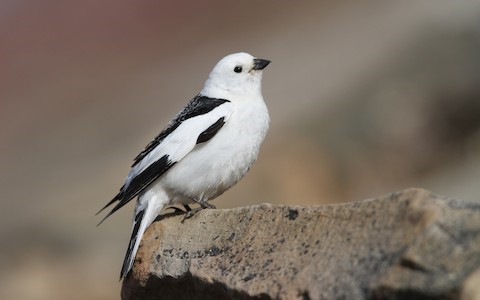
McKay’s Bunting, male in breeding plumage.  (Gambell, St. Lawrence Island, Alaska; May 30, 2018.)  © David Krueper

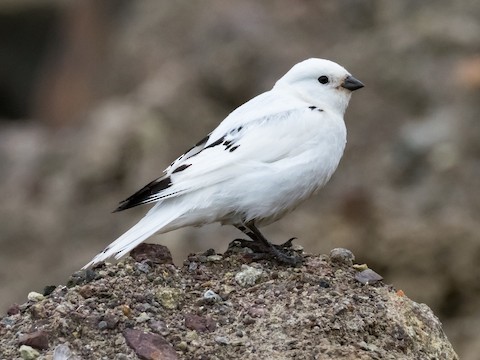
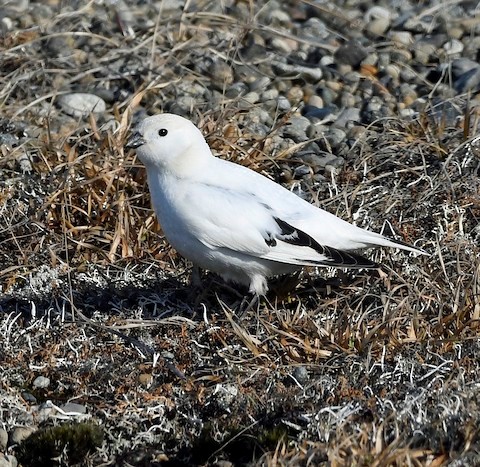
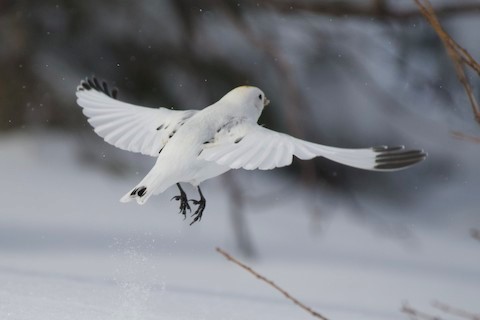
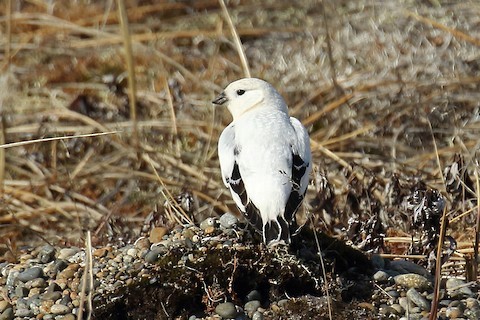
Males in breeding plumage are nearly all-white with contrasting black eyes and bill and black markings on the wings and tail.

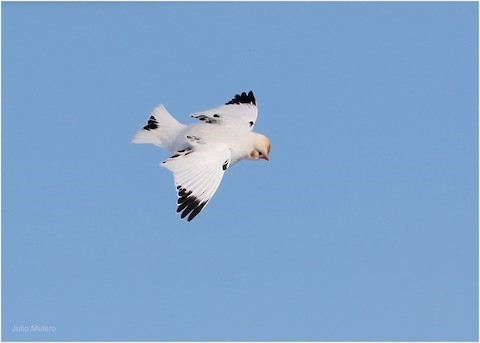
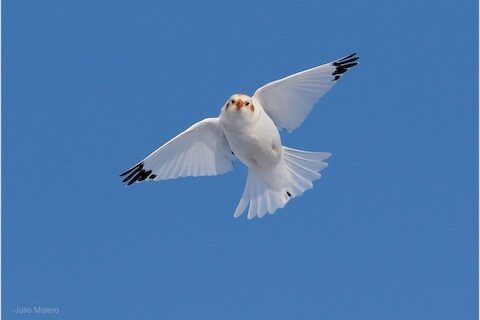
McKay’s Bunting, male in nonbreeding plumage showing typical black markings on the wings and tail.  (Icy View, Nome, Alaska; February 18, 2017.)  © Julio Mulero

On the wings, the tips of the outer primaries are black and there are usually a few black spots on the scapulars and on the wrist.  On the tail, the tips of the central tail feathers are usually black, but the tail can be all-white.

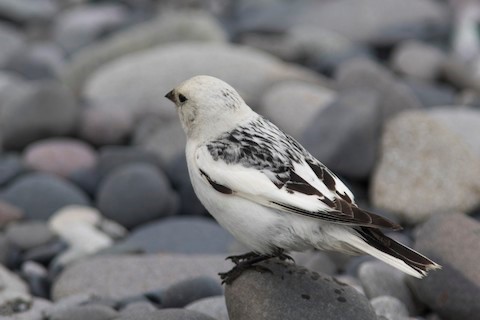
Nonbreeding males remain mostly white, with approximately the same pattern of black markings as on breeding males, but the bill turns yellow and they acquire an orangish or rusty wash on the crown and back, a rusty ear-patch, a rusty crescent on the side of the chest, and usually a few subtle dark streaks on the back.

McKay’s Bunting, male in nonbreeding plumage.  (Icy View, Nome, Alaska; March 28, 2022.)  © Richard Thunen

McKay’s Bunting, female in breeding plumage.  (St. Matthew Island, Alaska; June 28, 2018.)  © Bryce Robinson

Females in breeding plumage are white overall, with gray or blackish streaks on the back—but not on the rump.  The female’s wings and tail are much more extensively black than the male’s, more similar to a male Snow Bunting, with mostly-black primaries, scapulars, and central tail feathers.

McKay’s Bunting in nonbreeding plumage with fairly extensive rusty markings.  (Icy View, Nome, Alaska; December 8, 2016.)  © Andrew Spencer

McKay’s Bunting, female in nonbreeding plumage showing faint streaks on the back.  (Tsawwassen Ferry Terminal Jetty, Delta, British Columbia; December 10, 2019.)  © John Gordon

Females in nonbreeding plumage and first-winter birds have faintly or moderately streaked upperparts, yellow bills, and rusty or orangish markings on the head, chest, and flanks.  They can be indistinguishable from the palest nonbreeding Snow Buntings, but typically have an unmarked rump and all-white outer tail feathers.

Juveniles have pale-gray underparts and darker, streaked upperparts and wings.

McKay’s Bunting, juvenile.  (St. Matthew Island, Alaska; June 30, 2018.)  © Bryce Robinson

Voice.  The vocalizations of McKay’s are not known to differ from the Snow Bunting’s.  Breeding male gives a loud warbling song:Typical calls include: soft, musical rattles and twitters; a quick, fluty, descending whistle; and a brisk, nasal jrrt:

Notes

Monotypic species.  Sometimes regarded as conspecific with the widespread Snow Bunting (nivalis), which it effectively replaces as a breeder on St. Matthew and Hall Islands in the northern Bering Sea.

After conducting a thorough analysis of plumage variation among McKay’s and Snow Bunting specimens collected in western Alaska, Withrow (2020) concluded that McKay’s is most appropriately classified as a subspecies of Snow.  That conclusion was explicitly informed at least in part by the premise that McKay’s and Snow Buntings are allopatric.  However, the tiny breeding range of McKay’s falls entirely within Snow’s enormous breeding range, and they have been known to occur together and hybridize at least occasionally both on St. Matthew and on islands where the Snow Bunting predominates, so it may be more accurate to regard them as effectively sympatric breeders.  The persistence of McKay’s as a readily distinguishable form without substantial geographical isolation weighs in favor of full species status.

See below for comparison of McKay’s Bunting with the Snow Bunting.

Cf. Snow Bunting.  McKay’s Bunting may be regarded as either a separate species or a distinctive, highly localized form of Snow Bunting.  They occur together year-round throughout McKay’s’ very limited range, which comprises a just few islands and coasts of the Bering Sea.  McKay’s has been found several times in winter outside of its normal range, from south-coastal Alaska south to Oregon and once in summer along the northern coast of the Yukon Territory.

McKay’s Bunting, male in transition into breeding plumage.  (Icy View, Nome, Alaska; March 27, 2022.)  © Scott Page

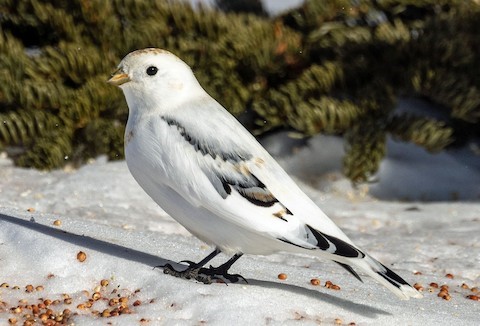
Snow Bunting, male in typical breeding plumage, with a solid-black back.  (Utqiaġvik, Alaska; June 28, 2022.)  © Timothy Piranian

As a general rule, McKay’s Buntings in all plumages have more white feathering and less black feathering than Snow Buntings in the equivalent plumage, but the differences are not always clear-cut.  Some individuals in some plumages may not be identifiable—and hybrids have been known to occur.  Nevertheless, male McKay’s are readily identifiable year-round based on the coloration of their backs and the patterns on their wings and tails.

Snow Bunting, an exceptionally pale male in transition into breeding plumage—if it had been photographed in or near Alaska, this individual would likely be identified as a female McKay’s Bunting.  (Whitby, Ontario; March 2, 2014.)  © Ed McAskill

McKay’s Bunting (as identified by the photographer) in nonbreeding, possibly first-winter plumage—not readily distinguishable from a Snow Bunting based on this photo.  (Icy View, Nome, Alaska; March 27, 2022.)  © Richard Thunen

Back Coloration:  In breeding plumage, male McKay’s has all-white body feathers above and below, whereas male Snow has an extensively black back.  In winter, male Snow Buntings’ backs change from black to a streaky blend of black and rusty-brown.  Nonbreeding male McKay’s often show some subtle streaking on the back, but remain much whiter above than any Snow Bunting.

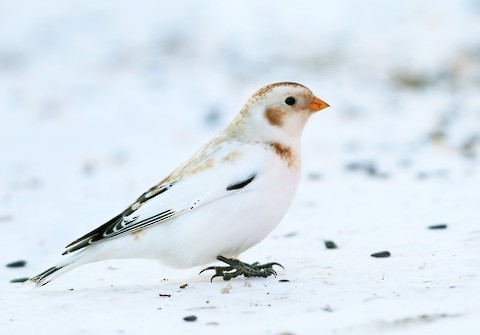
Snow Bunting in nonbreeding plumage, showing black central tail feathers and thin black lines on the outer webs of the outer tail feathers.  (Baie-du-Febvre, Nicolet-Yamaska, Quebec; January 21, 2022.)  © Daniel Jauvin

McKay’s Bunting, male in nonbreeding plumage showing black on the tips of the outer webs of all the tail feathers.  (Icy View, Nome, Alaska; March 28, 2022.)  © Scott Page

Wing Pattern:  Male McKay’s has a small and variable amount of black on the wings, usually confined to the tips of the primaries, and often a few black streaks or spots on the scapulars and alula (wrist).  Male Snow Buntings usually have entirely black primaries and alula, and all-black scapulars in breeding plumage.  In their nonbreeding plumage, the scapulars match the back coloration.  However, they vary widely in the extent of black in their wings, with the palest male Snows showing essentially the same pattern as the darkest male McKay’s.

Snow Bunting in nonbreeding plumage, showing black primaries and central tail feathers.  (Ottawa, Ontario; January 27, 2021.)  © Ken & Fay Broten

McKay’s Bunting, male showing black wingtips and almost entirely white tail feathers.  (Icy View, Nome, Alaska; February 18, 2017.)  © Julio Mulero

Tail Pattern:  There is generally little overlap in their tail patterns.  On male Snow Buntings the six central tail feathers (i.e., three on each side) are entirely black, and the outer tail feathers typically have black outer webs near the tip.  Male McKay’s typically show very little black on their tails, usually limited to the tips of the two or four central tail feathers.  Some male McKay’s have more extensive black on these feathers.

McKay’s Bunting, male showing limited black spots on the tail.  (Icy View, Nome, Alaska; March 23, 2023.)  © Josiah Verbrugge

McKay’s Bunting, male in breeding plumage with atypically extensive black on the tail.  (Gambell, St. Lawrence Island, Alaska; May 31, 2018.)  © Joe Wing

Female McKay’s and Snow are somewhat more similar than the males, and may not be distinguishable in all cases.  The key differences are: (1) the extent of white in the rump area; (2) the breadth of the white streaks on the back; (3) the presence or absence of dark streaks on the outer webs of the three outer tail feathers; and (4) the extent of white on the inner primaries and outer secondaries.  In all of these features, female McKay’s typically has more white and less black than female Snow.  However, judging from the comparisons of specimens presented by Withrow (2020), there appears to be at least marginal overlap in each of these features, such that the darkest female McKay’s and palest female Snow would be effectively identical.

McKay’s Bunting, female in breeding plumage, showing streaked back, white rump, and all-back central tail feathers.  (St. Matthew Island, Alaska; June 28, 2018.)  © Bryce Robinson

Snow Bunting, female in typical breeding plumage.  (St. Paul Island, Alaska; May 25, 2015.)  © Nigel Voaden

In their nonbreeding and transitional plumages, female McKay’s and both sexes of Snow Bunting can be much more difficult to distinguish.  All have variably streaked backs orangish or rusty-brown markings on the head.

McKay’s Bunting in nonbreeding plumage—apparently a relatively dark male based on the absence of visible black in the tail.  (Icy View, Nome, Alaska; December 8, 2016.)  © Andrew Spencer

Snow Bunting in typical nonbreeding plumage.  (Caldeira Seca, Morro Alto Natural Forest Reserve, Flores, Azores, Portugal; October 22, 2023.)  © Jean-Louis Carlo

Many nonbreeding Snow Buntings have heavily streaked upperparts, including the rump, and extensive markings on the head and chest, sometimes extending down to the flanks.  But many have all-white rumps, faintly streaked backs, and mostly white heads and chests.  The palest nonbreeding Snow Buntings may be indistinguishable from female McKay’s.

McKay’s Bunting, female in nonbreeding plumage.  (Tsawwassen Ferry Terminal Jetty, Delta, British Columbia; December 8, 2019.)  © Liron Gertsman

Snow Bunting in transition into nonbreeding plumage.  (Crooked River Wetlands Complex, Oregon; November 13, 2023.)  © Tom Crabtree

More Images of McKay’s Bunting

McKay’s Bunting, female in nonbreeding plumage.  (Damon Point, Ocean Shores, Washington; February 12, 2012.)  © Knut Hansen

McKay’s Bunting, males.  (Icy View, Nome, Alaska; March 27, 2023.)  © Aaron Lang

References

Alderfer, J., and J.L. Dunn. 2021. National Geographic Complete Birds of North America (Third Edition). National Geographic Society, Washington, D.C.

BirdLife International. 2020. Plectrophenax hyperboreus. The IUCN Red List of Threatened Species 2020: e.T22721046A137357547. https://dx.doi.org/10.2305/IUCN.UK.2020-3.RLTS.T22721046A137357547.en. (Accessed July 9, 2024.)

Brazil, M. 2009. Birds of East Asia. Princeton University Press.

eBird. 2024. eBird: An online database of bird distribution and abundance. Cornell Lab of Ornithology, Ithaca, N.Y. http://www.ebird.org. (Accessed July 9, 2024.)

Matsuoka, S. M., and Johnson, J. A. 2008. Using a multimodel approach to estimate the population size of McKay’s Buntings. Condor 110:371-376.

Sibley, D.A. 2014. The Sibley Guide to Birds (Second Edition). Alfred A. Knopf. New York.

Withrow, J. 2020, Plumage Variation in Bering Sea Plectrophenax Buntings and the Specific Status of McKay’s Bunting. Western Birds 51:174-189.

Xeno-Canto. 2024. McKay’s Bunting – Plectrophenax hyperboreus. https://xeno-canto.org/species/Plectrophenax-hyperboreus. (Accessed July 9, 2024.)

]]>
https://birdfinding.info/mckays-bunting/feed/ 2
Snow Bunting https://birdfinding.info/snow-bunting/ Wed, 28 Feb 2024 13:38:09 +0000 https://birdfinding.info/?p=138402

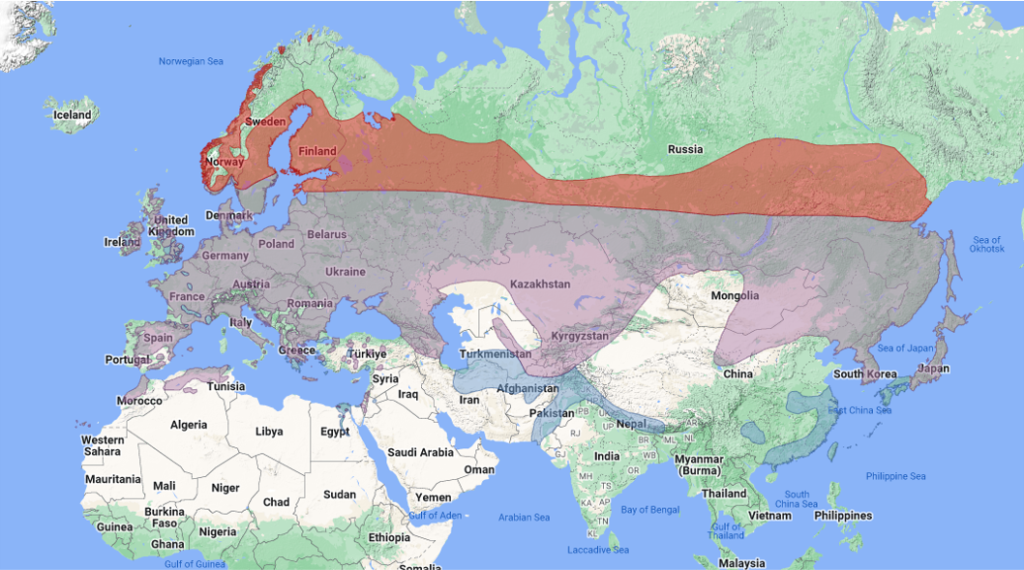
Birdfinding.info ⇒  The most northerly breeding songbird is common in many of the remote arctic territories where it nests.  In winter, it is locally common across a broad swath of southern Canada and the northern tier of the continental U.S.  Less common and widespread in Europe, where the largest wintering concentrations occur on Iceland and along coasts of the North Sea and southern Baltic Sea.  Apparently much more localized and less numerous in Asia, where regular wintering grounds include Novosibirsk Oblast (in southwestern Siberia), northern Inner Mongolia, and the eastern coast of Hokkaido.

Snow Bunting

Plectrophenax nivalis

Circumpolar breeder in arctic and subarctic regions.  Winters on barren plains, lakeshores, and seacoasts of the subarctic and cold temperate zones.

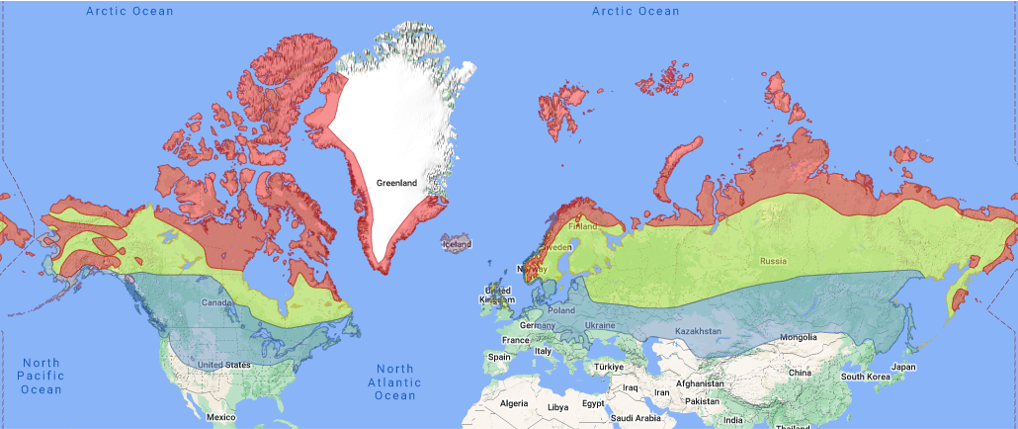
Approximate distribution of the Snow Bunting.  © Xeno-Canto 2024

Breeding.  Breeds on rocky tundra and in similar alpine and coastal habitats in upper latitudes of the Northern Hemisphere, including most, if not all, high arctic island groups north to Ellesmere Island, Greenland, Jan Mayen, Bear Island, Svalbard, Franz Josef Land, Novaya Zemlya, Severnaya Zemlya, and Wrangel Island.

Snow Buntings breed farther north than any other songbird species.  (Longyearbyen, Svalbard; June 5, 2015.)  © Christoph Moning

In North America, it breeds essentially throughout the arctic regions of Alaska and Canada, mainly near coasts, in mountains, and locally in other barren rocky areas.  In Alaska, it breeds along the Bering Sea coast and islands—but in very small numbers on St. Matthew and Hall Islands, where McKay’s Bunting mostly replaces it—south to the Aleutians and Alaska Peninsula; and in all the major mountain ranges south to Kodiak Island, the Kenai Peninsula, and the Wrangell and St. Elias ranges.  Also breeds locally in mountainous areas throughout the Yukon Territory and into northwestern British Columbia.  Eastward across northern Canada, it breeds throughout the Arctic Archipelago and mainly along the coasts south to southern Keewatin, the Belcher Islands, Ungava Bay, and the mountains of northern Labrador.

In Europe, it breeds on Iceland, in most parts of Norway, in adjacent parts of Sweden and northern Finland, and very locally in the Scottish highlands.  Eastward, it breeds across the arctic portions of the Russian Federation, mostly near the Arctic Ocean coastline and locally southward in some interior mountains: e.g., the northern Urals.  In the Russian Far East, it breeds along the Bering Sea coast and the northern coast of the Sea of Okhotsk, south locally to southern Kamchatka and the Commander Islands.

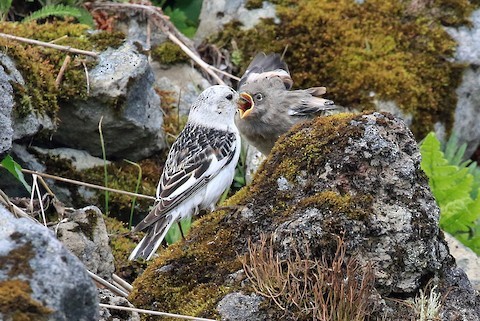
Snow Buntings typically breed on rocky tundra; female feeding hatchling.  (St. Paul Island, Alaska; June 18, 2016.)  © Phillip Edwards

Nonbreeding.  Winters along coasts of the North Atlantic and North Pacific, and across the interiors of Eurasia and North America, mainly in areas where freezing temperatures are frequent.  In winter, it can be found in all sorts of barren habitats, including coastal dunes, lakeshores, sparse grasslands, and stubble fields.

In northwestern North America, it winters along coasts from Kotzebue south to the Aleutians, east through southern Alaska, and sparsely south to Oregon.  In the interior, it winters from central Alaska and the Yukon Territory east across subarctic and southern Canada and south to the middle latitudes of the continental U.S.: to Utah, Colorado, Kansas, and the Ohio Valley.  Along the Atlantic coast of North America, it winters from southeastern Labrador south to the Outer Banks of North Carolina.

In western and northern Europe, it winters on Iceland, the British Isles, and coastally from southern Scandinavia south to Portugal.  In the interior, it winters from Germany, Poland, and the Baltic nations south to Bulgaria and Ukraine, and eastward sparsely across the steppes of southern Russia, Kazakhstan, Mongolia, and northern Inner Mongolia—apparently rare in most of its Asian wintering range.  In the Far East, it winters sparsely along coasts from the Chukchi Peninsula south to Hokkaido.

Many Snow Buntings winter along seacoasts.  (Eastern Point, Gloucester, Massachusetts; November 17, 2023.)  © Sam Zhang

Movements.  Southbound migrants typically arrive in wintering areas sometime between late October and early December, and depart in late February or March.

Vagrants regularly stray south of the normal wintering range as far as the Azores, Madeira, northern Mediterranean coasts and islands, South Korea, Honshu, central California, Tennessee, and Georgia.

More exceptional vagrants have been recorded south to the Canary Islands, southwestern Türkiye, Israel, Azerbaijan, the Yaeyama Islands (southwesternmost Japan), Midway Island, Hawaii, southern California, southeastern Arizona, southern Texas, and the central Bahamas.

Identification

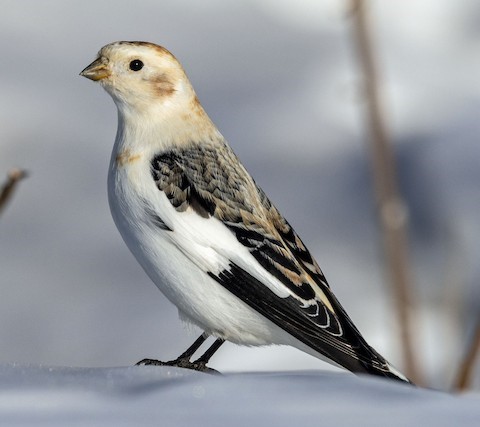
A relatively large, plump seedeater of cold, northern regions that is mostly black and white in breeding plumage.  In winter, it can often be recognized by its distinctive, but highly variable, “toasted marshmallow” coloration.

Most readily confused with the closely related, possibly conspecific, highly localized McKay’s Bunting, which is distinguished by more extensively white upperparts, wings, and tail.  (See detailed comparison below.)

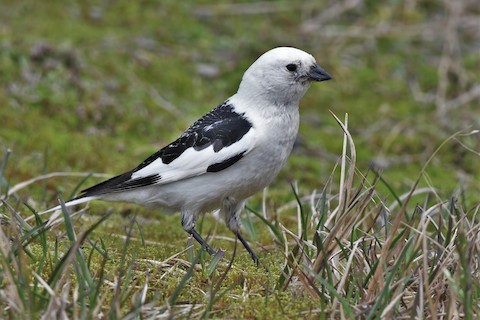
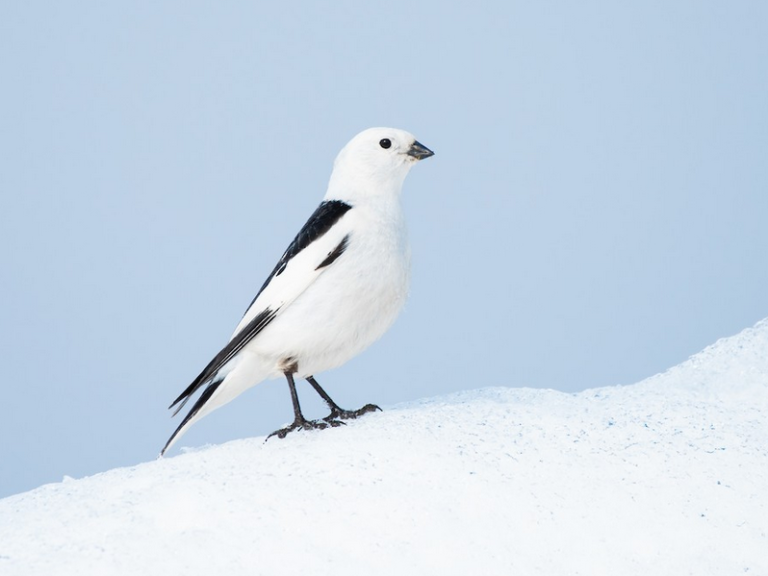
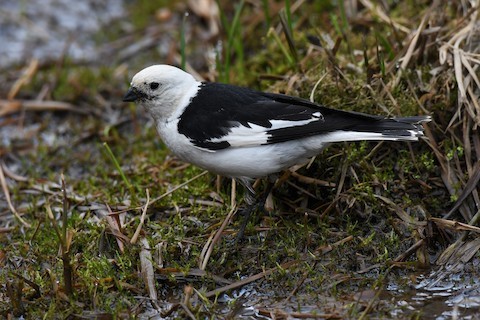
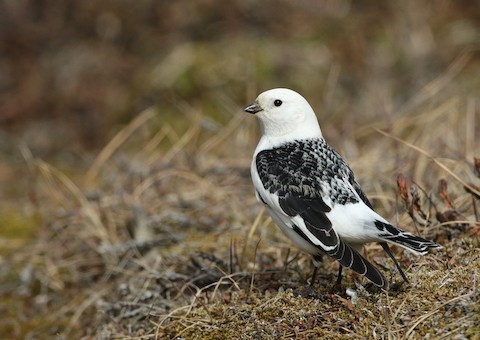
Snow Bunting, male in relatively dark breeding plumage.  (Utqiaġvik, Alaska; June 28, 2022.)  © Timothy Piranian

Males in breeding plumage are crisply attired in black and white.  The head and underparts are all-white, with a contrasting black bill and eye.  The upperparts, wings, and tail have patches of white and black.

The wings are mostly white with black shoulder-patches and all-black primaries.  The central tail feathers and adjacent uppertail coverts are black; the outer tail feathers and rump are white.

Snow Bunting, male in breeding plumage.  (Cake Eater Road, Utqiaġvik, Alaska; June 15, 2017.)  © Eric Gofreed

Most distinctively, the breeding male’s mantle and upper back are typically all-black—but on some paler individuals the upperparts are black with whitish edges on the feathers, appearing streaked or mottled.

Snow Bunting, male in pale breeding plumage, showing streaks on the back.  (Longyearbyen, Svalbard; May 27, 2018.)  © Luke Seitz

Snow Bunting, female in breeding plumage.  (St. Paul Island, Alaska; May 25, 2015.)  © Nigel Voaden

Females in breeding plumage resemble males, but with brown and gray spots and streaks mixed into the white and black of the upperparts, head, wings, and tail.

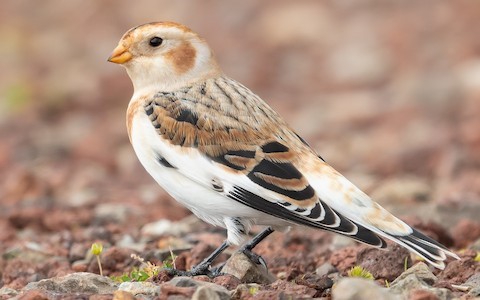
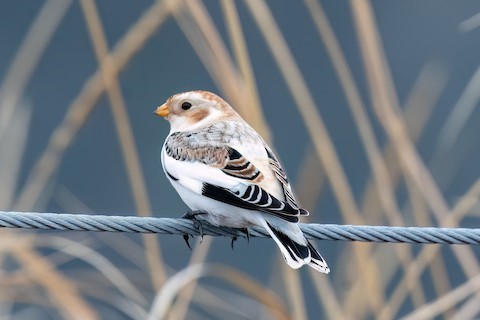
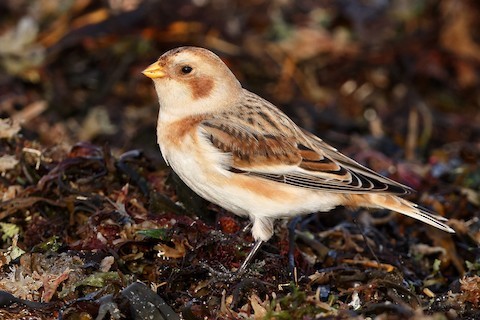
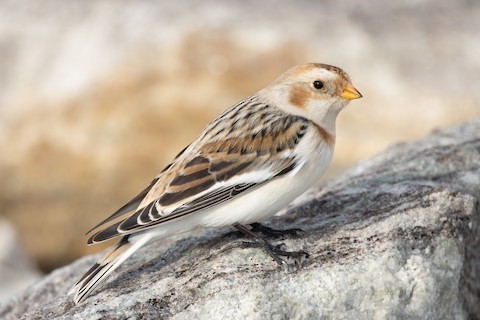
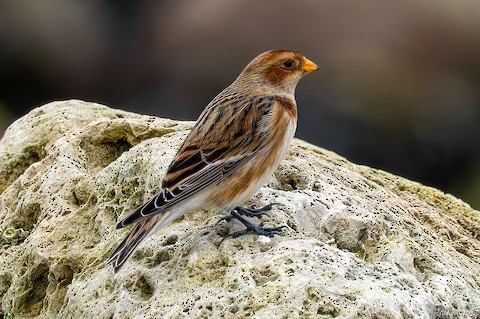
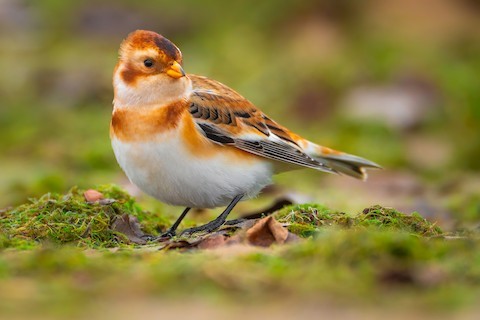
Males and females in nonbreeding plumage have streaked upperparts, yellow bills, and rusty or orangish markings on the head, chest, and flanks—the visual impression of these markings is often compared to a toasted marshmallow.

The extent and tone of these rusty markings are extremely variable.  Nonbreeding males may be paler overall than nonbreeding females, but their patterns and coloration apparently overlap, so they are not generally distinguishable.

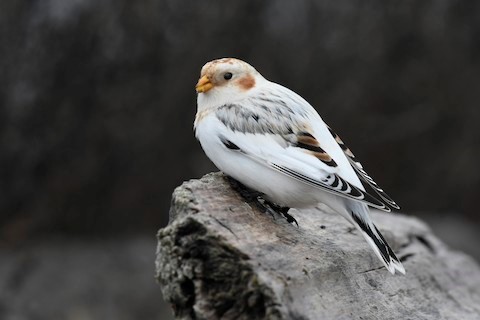
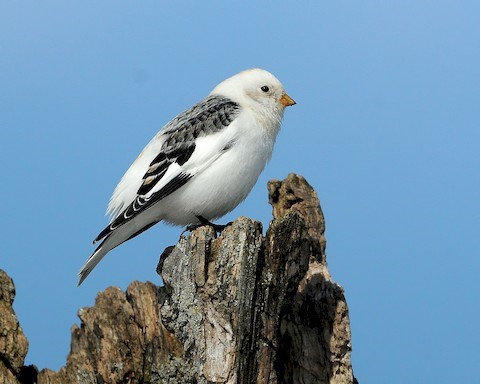
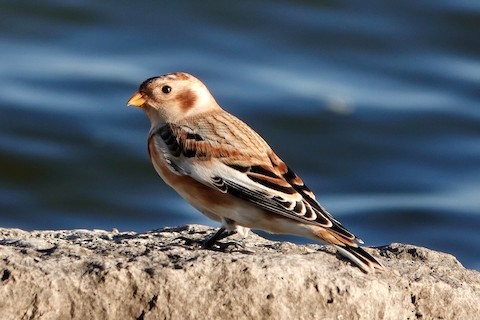
Snow Bunting in typical nonbreeding plumage.  (North Point State Park, Edgemere, Maryland; December 4, 2023.)  © Alex Pellegrini

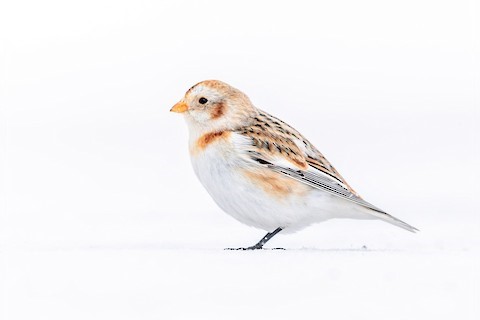
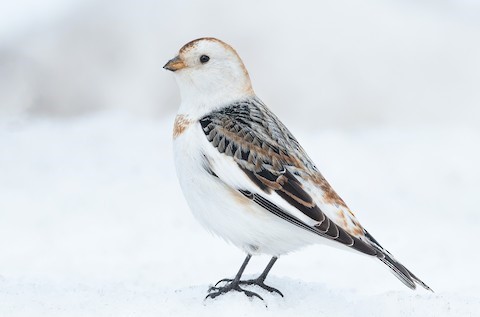
Snow Bunting in pale nonbreeding plumage.  (Hartford, Ohio; February 18, 2021.)  © Brad Imhoff

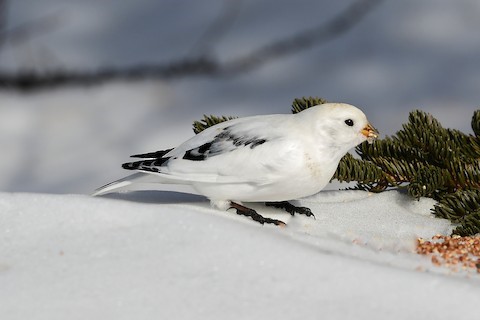
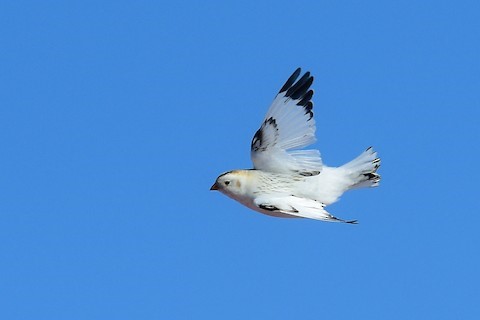
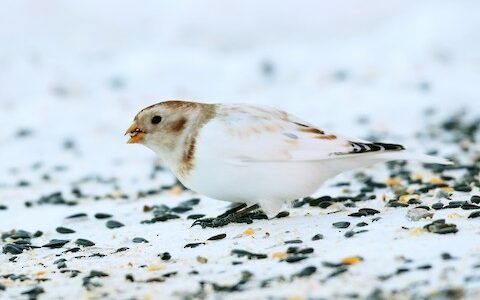
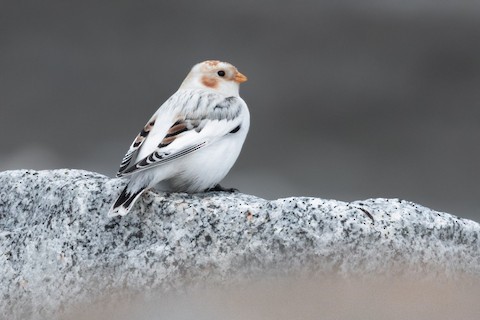
Pale individuals appear mostly white with lightly streaked upperparts, a rusty ear-patch, a rusty bar on the side of the chest, and a faint rusty tinge on the flank.

Dark individuals can appear mostly rusty or brownish both above and below, always with a pronounced rusty-brown ear-patch.

Snow Bunting in darker nonbreeding plumage.  (Governor Nelson State Park, Westport, Wisconsin; October 30, 2021.)  © Melissa Kesling

Snow Bunting in very dark nonbreeding plumage.  (South Shields Pier, Newcastle-upon-Tyne, England; January 9, 2022.)  © Chris Cummings

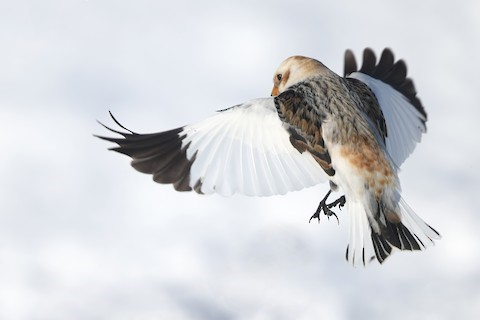
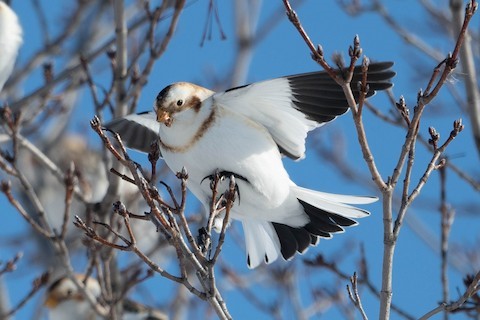
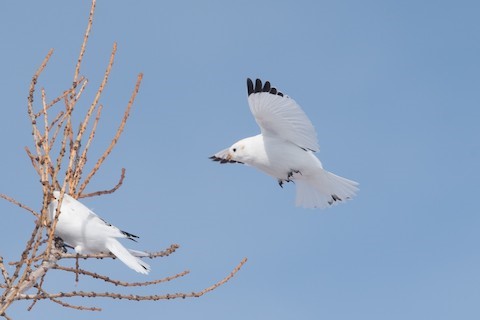
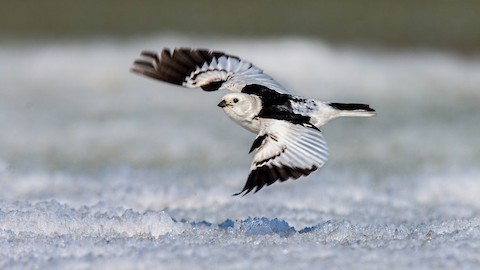
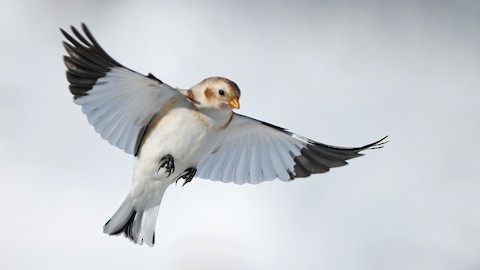
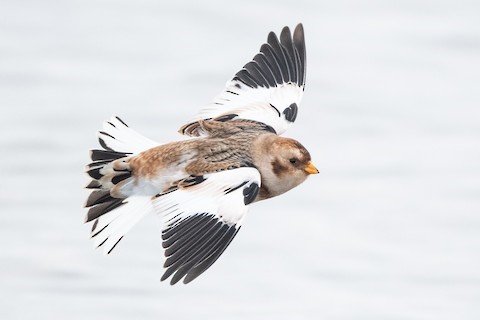
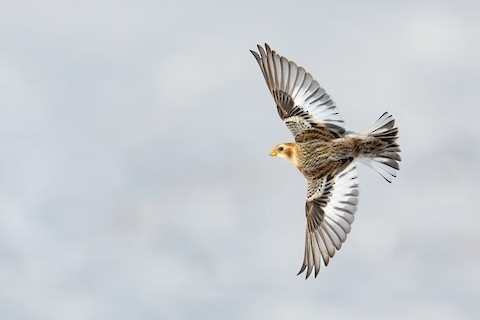
On nonbreeding adults in flight, the boldly contrasting black-and-white wing and tail patterns are distinctive.

Snow Bunting in nonbreeding plumage.  (Baie-du-Febvre, Nicolet-Yamaska, Quebec; January 21, 2022.)  © Daniel Jauvin

Snow Bunting in nonbreeding plumage, a dark individual showing mostly brownish upperparts and contrasting black-and-white patches on the wings and tail.  (Pointe de la Croix, La Haute-Côte-Nord, Quebec; November 18, 2022.)  © David Turgeon

First-winter birds are much more heavily streaked, and may appear mostly brown-and-black overall.  In flight, the wings often appear mostly gray with limited patches on the secondaries and outer tail feathers.

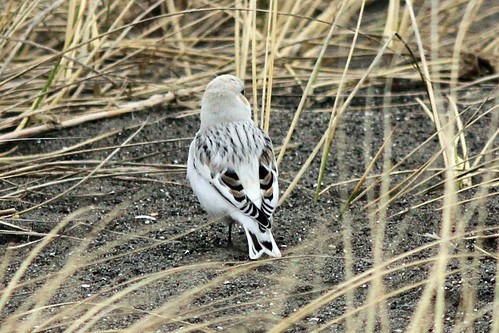
Snow Bunting in nonbreeding plumage, showing mostly brown streaked upperparts with limited white patches in secondaries and outer tail feathers.  (Indianapolis Regional Airport, Indiana; February 5, 2022.)  © Ryan Sanderson

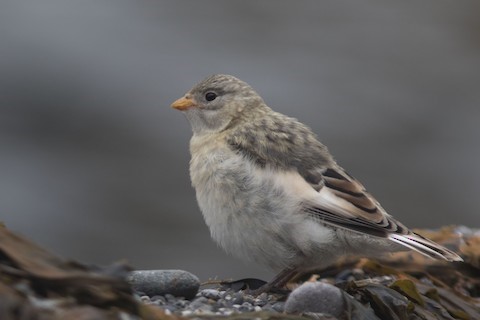
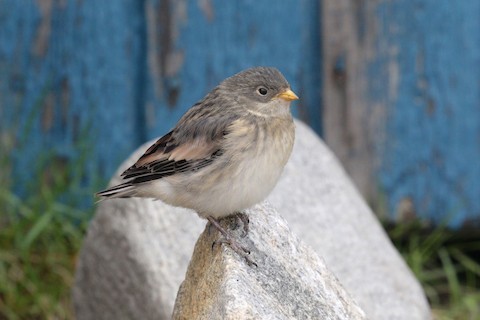
Snow Bunting, juvenile.  (Nuuk, Greenland; July 9, 2022.)  © Noah Strycker

Juveniles are mostly gray overall, usually darkest around the face.  The back and wings are more brownish and streaked blackish.

Voice.  Breeding male gives a loud warbling song, which has been rendered as: hudidi feet feet feew, hudidi feet feet feew, hudidi or swito-süvee-vitüta-süveh:Typical calls include a soft, musical rattle or twitter:Often gives a quick, fluty, descending whistle as well:Sometimes also gives a brisk, nasal jrrt:

Notes

Polytypic species consisting of four recognized subspecies.  Sometimes regarded as conspecific with McKay’s Bunting (hyperboreus), which mostly replaces the Snow Bunting as a breeder on St. Matthew and Hall Islands in the northern Bering Sea.

After conducting a thorough analysis of plumage variation among McKay’s and Snow Bunting specimens collected in western Alaska, Withrow (2020) concluded that McKay’s is most appropriately classified as a subspecies of Snow.  That conclusion was explicitly informed at least in part by the premise that McKay’s and Snow Buntings are allopatric.  However, the tiny breeding range of McKay’s falls entirely within Snow’s enormous breeding range, and they have been known to occur together and hybridize at least occasionally both on St. Matthew and on islands where the Snow Bunting predominates, so it may be more accurate to regard them as effectively sympatric breeders.  The persistence of McKay’s as a readily distinguishable form without substantial geographical isolation weighs in favor of full species status.

See below for a comparison of the Snow Bunting with McKay’s Bunting.

Cf. McKay’s Bunting.  McKay’s Bunting may be regarded as either a separate species or a distinctive, highly localized form of Snow Bunting.  They occur together year-round throughout McKay’s’ very limited range, which comprises a just few islands and coasts of the Bering Sea.  McKay’s has been found several times in winter outside of its normal range, from south-coastal Alaska south to Oregon and once in summer along the northern coast of the Yukon Territory.

McKay’s Bunting, male in transition into breeding plumage.  (Icy View, Nome, Alaska; March 27, 2022.)  © Scott Page

Snow Bunting, male in typical breeding plumage, with a solid-black back.  (Utqiaġvik, Alaska; June 28, 2022.)  © Timothy Piranian

As a general rule, McKay’s Buntings in all plumages have more white feathering and less black feathering than Snow Buntings in the equivalent plumage, but the differences are not always clear-cut.  Some individuals in some plumages may not be identifiable—and hybrids have been known to occur.  Nevertheless, male McKay’s are readily identifiable year-round based on the coloration of their backs and the patterns on their wings and tails.

Snow Bunting, an exceptionally pale male in transition into breeding plumage—if it had been photographed in or near Alaska, this individual would likely be identified as a female McKay’s Bunting.  (Whitby, Ontario; March 2, 2014.)  © Ed McAskill

McKay’s Bunting (as identified by the photographer) in nonbreeding, possibly first-winter plumage—not readily distinguishable from a Snow Bunting based on this photo.  (Icy View, Nome, Alaska; March 27, 2022.)  © Richard Thunen

Back Coloration:  In breeding plumage, male McKay’s has all-white body feathers above and below, whereas male Snow has an extensively black back.  In winter, male Snow Buntings’ backs change from black to a streaky blend of black and rusty-brown.  Nonbreeding male McKay’s often show some subtle streaking on the back, but remain much whiter above than any Snow Bunting.

Snow Bunting in nonbreeding plumage, showing black central tail feathers and thin black lines on the outer webs of the outer tail feathers.  (Baie-du-Febvre, Nicolet-Yamaska, Quebec; January 21, 2022.)  © Daniel Jauvin

McKay’s Bunting, male in nonbreeding plumage showing black on the tips of the outer webs of all the tail feathers.  (Icy View, Nome, Alaska; March 28, 2022.)  © Scott Page

Wing Pattern:  Male McKay’s has a small and variable amount of black on the wings, usually confined to the tips of the primaries, and often a few black streaks or spots on the scapulars and alula (wrist).  Male Snow Buntings usually have entirely black primaries and alula, and all-black scapulars in breeding plumage.  In their nonbreeding plumage, the scapulars match the back coloration.  However, they vary widely in the extent of black in their wings, with the palest male Snows showing essentially the same pattern as the darkest male McKay’s.

Snow Bunting in nonbreeding plumage, showing black primaries and central tail feathers.  (Ottawa, Ontario; January 27, 2021.)  © Ken & Fay Broten

McKay’s Bunting, male showing black wingtips and almost entirely white tail feathers.  (Icy View, Nome, Alaska; February 18, 2017.)  © Julio Mulero

Tail Pattern:  There is generally little overlap in their tail patterns.  On male Snow Buntings the six central tail feathers (i.e., three on each side) are entirely black, and the outer tail feathers typically have black outer webs near the tip.  Male McKay’s typically show very little black on their tails, usually limited to the tips of the two or four central tail feathers.  Some male McKay’s have more extensive black on these feathers.

McKay’s Bunting, male showing limited black spots on the tail.  (Icy View, Nome, Alaska; March 23, 2023.)  © Josiah Verbrugge

McKay’s Bunting, male in breeding plumage with atypically extensive black on the tail.  (Gambell, St. Lawrence Island, Alaska; May 31, 2018.)  © Joe Wing

Female McKay’s and Snow are somewhat more similar than the males, and may not be distinguishable in all cases.  The key differences are: (1) the extent of white in the rump area; (2) the breadth of the white streaks on the back; (3) the presence or absence of dark streaks on the outer webs of the three outer tail feathers; and (4) the extent of white on the inner primaries and outer secondaries.  In all of these features, female McKay’s typically has more white and less black than female Snow.  However, judging from the comparisons of specimens presented by Withrow (2020), there appears to be at least marginal overlap in each of these features, such that the darkest female McKay’s and palest female Snow would be effectively identical.

McKay’s Bunting, female in breeding plumage, showing streaked back, white rump, and all-back central tail feathers.  (St. Matthew Island, Alaska; June 28, 2018.)  © Bryce Robinson

Snow Bunting, female in typical breeding plumage.  (St. Paul Island, Alaska; May 25, 2015.)  © Nigel Voaden

In their nonbreeding and transitional plumages, female McKay’s and both sexes of Snow Bunting can be much more difficult to distinguish.  All have variably streaked backs orangish or rusty-brown markings on the head.

McKay’s Bunting in nonbreeding plumage—apparently a relatively dark male based on the absence of visible black in the tail.  (Icy View, Nome, Alaska; December 8, 2016.)  © Andrew Spencer

Snow Bunting in typical nonbreeding plumage.  (Caldeira Seca, Morro Alto Natural Forest Reserve, Flores, Azores, Portugal; October 22, 2023.)  © Jean-Louis Carlo

Many nonbreeding Snow Buntings have heavily streaked upperparts, including the rump, and extensive markings on the head and chest, sometimes extending down to the flanks.  But many have all-white rumps, faintly streaked backs, and mostly white heads and chests.  The palest nonbreeding Snow Buntings may be indistinguishable from female McKay’s.

McKay’s Bunting, female in nonbreeding plumage.  (Tsawwassen Ferry Terminal Jetty, Delta, British Columbia; December 8, 2019.)  © Liron Gertsman

Snow Bunting in transition into nonbreeding plumage.  (Crooked River Wetlands Complex, Oregon; November 13, 2023.)  © Tom Crabtree

More Images of the Snow Bunting

Snow Bunting in nonbreeding plumage—exceptionally rich rusty-orange.  (Montrose Point Bird Sanctuary, Lincoln Park, Chicago, Illinois; November 12, 2022.)  © Matt Zuro

Snow Bunting in transition into breeding plumage.  (St.-Bruno, Lac-Saint-Jean-Est, Quebec; April 9, 2022.)  © Simon Boivin

References

Alderfer, J., and J.L. Dunn. 2021. National Geographic Complete Birds of North America (Third Edition). National Geographic Society, Washington, D.C.

BirdLife International. 2016. Plectrophenax nivalis. The IUCN Red List of Threatened Species 2016: e.T22721043A89345729. https://dx.doi.org/10.2305/IUCN.UK.2016-3.RLTS.T22721043A89345729.en. (Accessed January 28, 2024.)

Brazil, M. 2009. Birds of East Asia. Princeton University Press.

eBird. 2024. eBird: An online database of bird distribution and abundance. Cornell Lab of Ornithology, Ithaca, N.Y. http://www.ebird.org. (Accessed January 28, 2024.)

Garcia-del-Rey, E. 2011. Field Guide to the Birds of Macaronesia: Azores, Madeira, Canary Islands, Cape Verde. Lynx Editions, Barcelona.

Garcia-del-Rey, E. 2018. Birds of the Canary Islands. Christopher Helm, London.

Johnson, S.R., and D.R. Herter. 1989. The Birds of the Beaufort Sea. BP Exploration (Alaska) Inc., Anchorage, Alaska.

Kirwan, G.M., A. Levesque, M. Oberle, and C.J. Sharpe. 2019. Birds of the West Indies. Lynx Edicions, Barcelona.

Pyle, R.L., and P. Pyle. 2017. The Birds of the Hawaiian Islands: Occurrence, History, Distribution, and Status. Version 2 (January 1, 2017). http://hbs.bishopmuseum.org/birds/rlp-monograph/. B.P. Bishop Museum, Honolulu, Hawaii.

Salt, W.R., and J.R. Salt. 1976. The Birds of Alberta. Hurtig Publishers, Edmonton, Alberta.

Sibley, D.A. 2014. The Sibley Guide to Birds (Second Edition). Alfred A. Knopf. New York.

Svensson, L., K. Mullarney, and D. Zetterström. 2009. Birds of Europe (Second Edition). Princeton University Press.

Withrow, J. 2020, Plumage Variation in Bering Sea Plectrophenax Buntings and the Specific Status of McKay’s Bunting. Western Birds 51:174-189.

Xeno-Canto. 2024. Snow Bunting – Plectrophenax nivalis. https://xeno-canto.org/species/Plectrophenax-nivalis. (Accessed January 28, 2024.)

]]>
Eastern Barn Owl https://birdfinding.info/eastern-barn-owl/ https://birdfinding.info/eastern-barn-owl/#comments Wed, 17 Jan 2024 13:37:28 +0000 https://birdfinding.info/?p=137825

Birdfinding.info ⇒  Widespread and fairly common in several portions of its extensive range, including large swaths of India and Australia and the main islands of Fiji and Samoa.  Comparatively scarce or localized in Southeast Asia and Indonesia.

Eastern Barn Owl

Tyto javanica

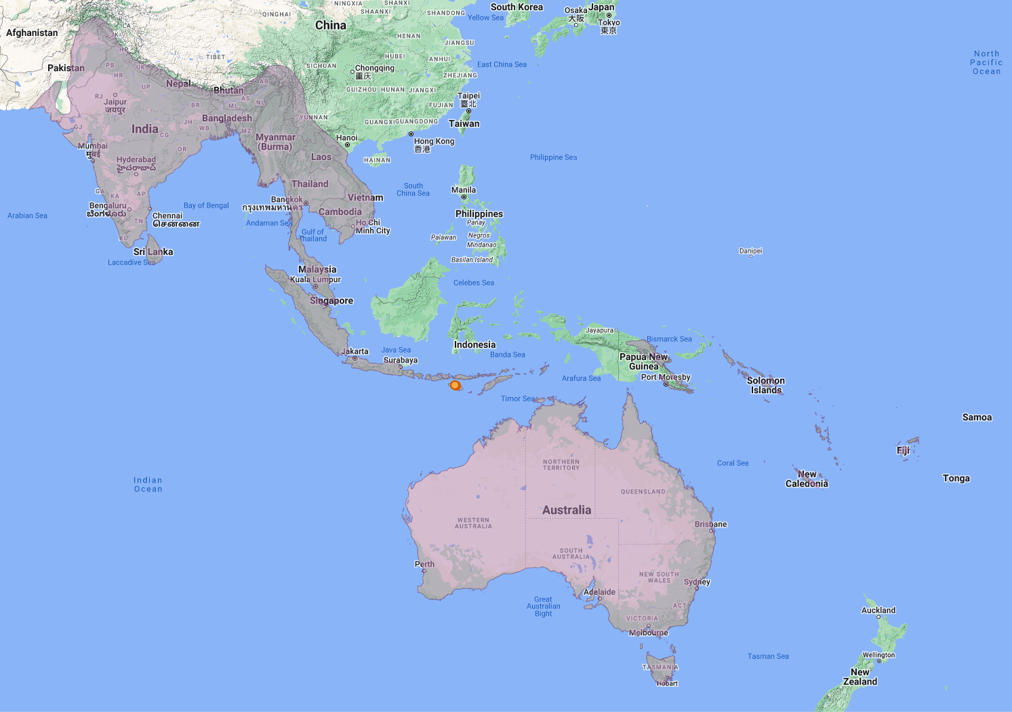
South Asia to western Polynesia.

Approximate distribution of the Eastern Barn Owl.  © Xeno-Canto 2023

Comprises two potentially distinct forms: the widespread “Eastern Barn Owl” (javanica) and the localized, insular, little-known “Boang Barn Owl” (crassirostris) of the Tanga Islands in the Bismarck Archipelago.  The status of crassirostris is unclear due to a lack of published documentation.

Resident essentially throughout the Indian subcontinent west to the Indus River Valley of Pakistan, north to the foothills of the Himalayas, and south to Sri Lanka.  Also resident essentially throughout Southeast Asia, mainly in lowlands, north locally or sporadically across the Chinese border into Yunnan, Guangxi, southwesternmost Guangdong, and Hainan, and south to Singapore.

In Indonesia, resident on Sumatra, Java, and the Lesser Sundas from Bali to Timor.  Apparently resident locally in northern Borneo (Sabah and adjacent areas) and possibly also in southern Borneo.  A rare, localized resident of eastern New Guinea, where most records are from the environs of Port Moresby, with a few scattered reports elsewhere, including the adjacent islands Manam and Karkar.

In Australia, resident essentially throughout the mainland and on some adjacent islands, including Kangaroo Island.  Either a rare, localized resident or an occasional visitor to northern Tasmania.

In Melanesia, resident on New Caledonia, the Loyalty Islands, Vanuatu, and the southern Solomon Islands (Guadalcanal, Rennell, and Santa Cruz).  In Polynesia, resident on Fiji, Wallis and Futuna, Tonga, Samoa, and Niue.

Starting around 2008, a few individuals have been reported from North Island, New Zealand, mainly around Kaitaia, but also much farther south, possibly indicating the establishment of a new population.

Identification

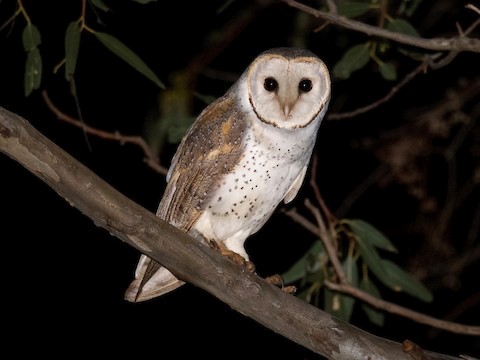
A medium-sized, pale barn owl, slightly smaller and usually paler than the similar Tyto species that overlap with it.  Sometimes recognizable by its narrower, more heart-shaped facial disk.

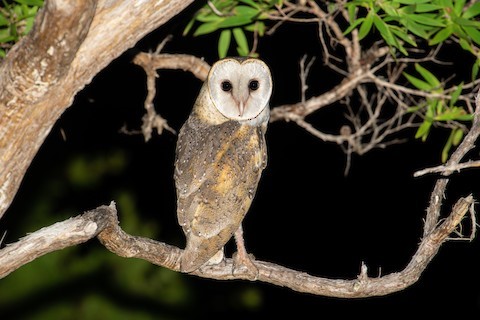
Eastern Barn Owl.  (Kairi, Tablelands, Queensland, Australia; January 6, 2020.)  © JJ Harrison, 

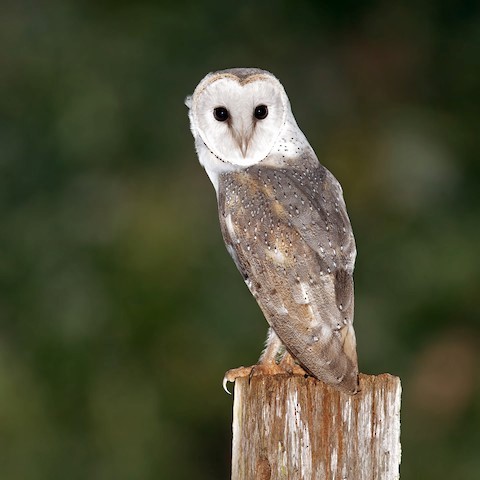
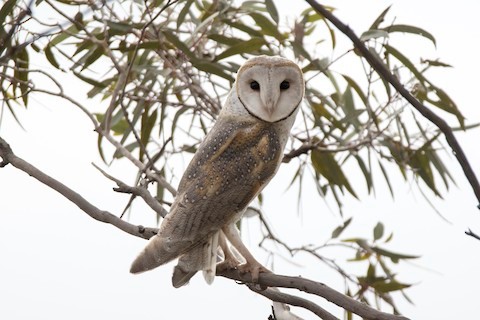
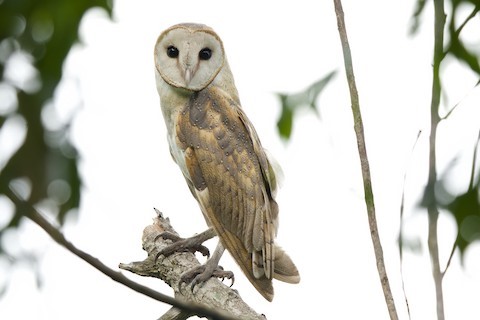
The upperparts are usually blotchy gray-brown and tan with white spots on the wing coverts and back.  Some individuals are grayer overall, and others are more brownish or infused with buffy or rusty tones.

Eastern Barn Owl.  (Yarriambiack, Victoria, Australia; July 22, 2020.)  © John Cantwell

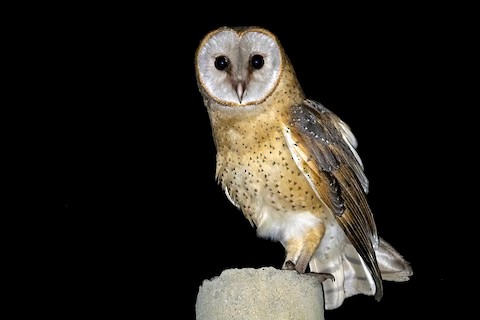
The underparts are white or buffy with dark spots.  Males are smaller and tend to appear all-white below with sparse spotting.  Females vary from white to orange-buffy below, and are often densely spotted.

Eastern Barn Owl, typical male with mostly white underparts.  (Vekariya, Ahmedabad, Gujarat, India; October 25, 2020.)  © Bhaarat Vyas

Eastern Barn Owl, female with relatively dark buffy underparts and rusty upperparts.  (Kallara, Kerala, India; March 10, 2023.)  © Sree

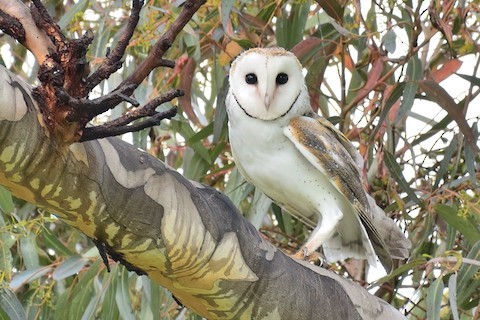
The facial disk typically appears white or whitish, sometimes grayish or tan, framed by a thin rim that is usually golden-brown above and darker below.

Eastern Barn Owl, showing uppersides of wings and tail.  (Royal Park, Melbourne, Victoria, Australia; September 4, 2021.)  © Ken Tay

Eastern Barn Owl.  (Rupanyup, Yarriambiack, Victoria, Australia; July 2, 2018.)  © Leigh Pieterse

“Boang Barn Owl”.  A form of barn owl described from the Tanga Islands is reportedly “markedly darker in plumage, stronger talons and a stronger, thicker bill” than the typical, widespread Eastern Barn Owl.  (König and Weick 2008)  Apparently no photos of this form are publicly available.

Voice.  Typical calls include rasps:Harsh screams:And clearer, more plaintive screams:

Notes

Polytypic species consisting of seven recognized subspecies that represent two potentially distinct forms: the “Eastern Barn Owl” (javanica plus five others) and the “Boang Barn Owl” (crassirostris).

Both recent guidebooks to the owls of the world, König and Weick (2008) and Mikkola (2013), treat the “Boang Barn Owl” as a separate species based on reported morphological differences: i.e., stronger talons and a stronger, thicker bill than in other Eastern Barn Owls.  Documentation of these differences is not readily available, and it seems inherently dubious that the “Boang” form’s reported range, the Tanga Islands, with less than 60 square kilometers of land, contain enough habitat to sustain an isolated population of barn owls.

Worldwide barn owl taxonomy is unsettled.  The Eastern Barn Owl has traditionally been classified together with many other taxa as comprising the cosmopolitan Barn Owl, Tyto alba.  Many, if not most, taxonomic authorities maintain this classification.  However, the emerging consensus is that the traditional T. alba represents three major lineages that should each be recognized as one or more species: the Western Barn Owl (alba) of western Eurasia and Africa; the Eastern Barn Owl (javanica) of southern Asia and Australasia; and the American Barn Owl (furcata) of the New World.

More Images of the Eastern Barn Owl

Eastern Barn Owl.  (Iron Range National Park, Queensland, Australia; December 22, 2019.)  © Louis Backstrom

Eastern Barn Owl.  (Lam Toi Ting, Nong Chok, Bangkok, Thailand; July 1, 2023.)  © Sam Hambly

Eastern Barn Owl.  (Royal Park, Melbourne, Victoria, Australia; September 4, 2021.)  © Ken Tay

Eastern Barn Owl.  (Hainan, China.)  © Su Li

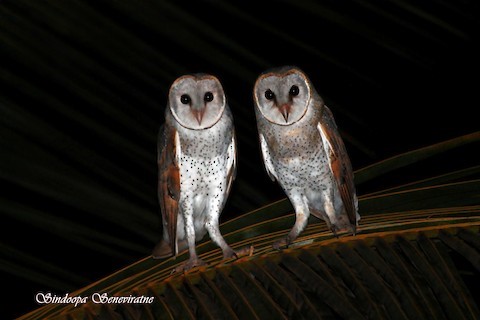
Eastern Barn Owl.  (Mannar, Sri Lanka; April 21, 2016.)  © Sindoopa Seneviratne

Eastern Barn Owl.  (Running Creek, Scenic Rim, Queensland, Australia; May 2, 2021.)  © Steven McBride

Eastern Barn Owl.  (University of Jammu, Jammu, India; August 18, 2022.)  © Parmil Kumar

References

Aliabadian, M., N. Alaei-Kakhki, O. Mirshamsi, V. Nijman, and A. Roulin. 2016. Phylogeny, biogeography, and diversification of barn owls (Aves: Strigiformes). Biological Journal of the Linnean Society 119:904-918.

BirdLife International. 2019. Tyto alba (amended version of 2016 assessment). The IUCN Red List of Threatened Species 2019: e.T22688504A155542941. https://dx.doi.org/10.2305/IUCN.UK.2019-3.RLTS.T22688504A155542941.en. (Accessed December 12, 2023.)

eBird. 2023. eBird: An online database of bird distribution and abundance. Cornell Lab of Ornithology, Ithaca, N.Y. http://www.ebird.org. (Accessed December 12, 2023.)

iNaturalist. 2023. https://www.inaturalist.org/. (Accessed December 12, 2023.)

König, C., and F. Weick. 2008. Owls of the World (Second Edition). Yale University Press.

Mikkola, H. 2013. Owls of the World: A Photographic Guide (Second Edition). Firefly Books, London.

Pizzey, G., and F. Knight. 2012. The Field Guide to the Birds of Australia. HarperCollins, New York.

Robson, C. 2002. Birds of Thailand. Princeton University Press.

Treesucon, U. and W. Limparungpatthanakij. 2018. Birds of Thailand. Lynx Edicions, Barcelona.

Xeno-Canto. 2023. Eastern Barn Owl – Tyto javanica. https://xeno-canto.org/species/Tyto-javanica. (Accessed December 12, 2023.)

]]>
https://birdfinding.info/eastern-barn-owl/feed/ 1
Calcariidae: Longspurs https://birdfinding.info/family-calcariidae/ Sat, 09 Dec 2023 22:17:18 +0000 https://birdfinding.info/?p=137753

Calcariidae: Longspurs

The longspurs are a small family of seedeaters that breed on arctic tundra and North American prairies. Formerly classified together with Old World buntings (Emberizidae) and New World Sparrows (Arremonidae), which they resemble, longspurs have been reclassified as a separate family based on genetic analyses of relatedness.

Two species are abundant, widespread, circumpolar arctic breeders that winter in temperate latitudes of Eurasia and North America.  Of these, the Lapland Longspur (Calcarius lapponicus) is especially widespread and abundant, the most numerous arctic-breeding passerine.  Two more species are rare-to-uncommon, localized breeders of the North American arctic.  The remaining two species breed on short-grass prairies, and are uncommon due mainly to loss of habitat.

Males of all six species have a bold alternate breeding plumage and a drab basic plumage that resembles the female.  On their wintering grounds they inhabit open grasslands where they are often difficult to observe and identify.

The internal taxonomy of the family is well-established, except that one traditionally recognized species, McKay’s Bunting (Plectrophenax hyperboreus), is sometimes considered a distinctive, highly localized form of the much more widespread Snow Bunting (P. nivalis).

Lapland Longspur (Calcarius lapponicus)

Chestnut-collared Longspur (Calcarius ornatus)

Smith’s Longspur (Calcarius pictus)

Thick-billed Longspur (Rhynchophanes mccownii)

Snow Bunting (Plectrophenax nivalis)

McKay’s Bunting (Plectrophenax hyperboreus)

References

Barker, F.K., K.J. Burns, J. Klicka, S.M. Lanyon, and I.J. Lovette. 2013. Going to extremes: contrasting rates of diversification in a recent radiation of New World passerine birds. Systematic Biology 62:298-320.

Barker, F.K., K.J. Burns, J. Klicka, S.M. Lanyon, and I.J. Lovette. 2015. New insights into New World biogeography: An integrated view from the phylogeny of blackbirds, cardinals, sparrows, tanagers, warblers, and allies. Auk 132:333-348.

Boyd, J.H., 2023. Taxonomy in Flux: Core Passeroidea III: Calcariidae, Emberizidae, Arremonidae. http://jboyd.net/Taxo/List30.html. (Posted July 22, 2023. Accessed December 9, 2023.)

Roberson, D. 2016. Bird Families of the World: Longspurs & Snow Buntings, Calcariidae. http://creagrus.home.montereybay.com/longspurs.html. (Posted February 15, 2016. Accessed December 9, 2023.)

Text © Russell Fraker / December 9, 2023

]]>
Cape Verde Barn Owl https://birdfinding.info/cape-verde-barn-owl/ https://birdfinding.info/cape-verde-barn-owl/#comments Fri, 08 Dec 2023 15:23:08 +0000 https://birdfinding.info/?p=137621

Birdfinding.info ⇒  An uncommon, localized, little-known Cape Verde endemic with a limited distribution.  It has been found most consistently around the Barragem de Poilão on Santiago.

Cape Verde Barn Owl

Tyto detorta

Endemic to the Cape Verde Archipelago, where it apparently occurs on most islands, with recent records from Santo Antão, São Pedro, Ilhéu Branco, Ilhéu Raso, Santa Luzia, São Nicolau, Boavista, Santiago, Maio, Santiago, Fogo, Brava, Ilhéu Grande, and Ilhéu de Cima.  (The only major island in the archipelago that apparently has no recent records is Sal.)

Identification

A relatively colorful barn owl, with rich buffy or orange plumage.  It may be the only barn owl expected on Cape Verde—however, Mikkola (2013) writes that the “African Barn Owl” also occurs there.

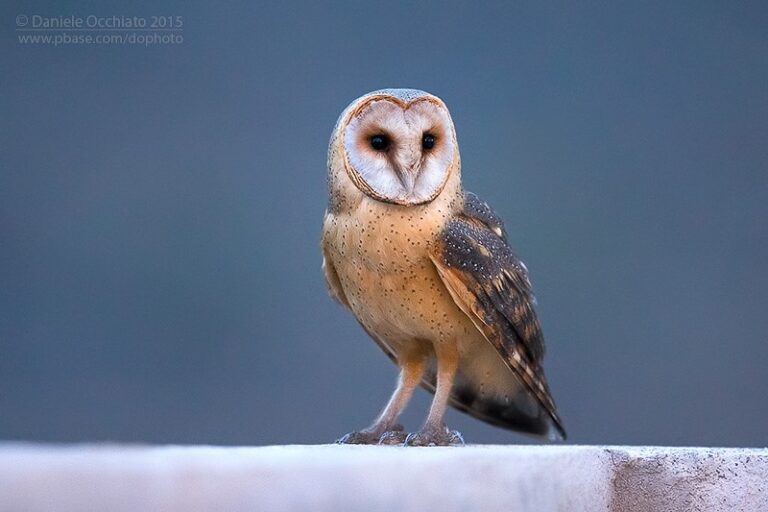
Cape Verde Barn Owl with buffy underparts and pinkish-white facial disk.  (Barragem de Poilão, Santiago, Cape Verde; March 21, 2015.)  © Daniele Occhiato

Cape Verde Barn Owl.  (Boavista, Cape Verde; May 25, 2004.)  © Pedro Lopez Suarez

The upperparts are mostly gray or gray-brown with white spots on the wing coverts and back.

The underparts are mostly buffy or orange with dark spots.

Cape Verde Barn Owl with orange-buffy underparts and facial disk.  (Barragem de Poilão, Santiago, Cape Verde; March 4, 2012.)  © Eric Didner

The facial disk typically appears either pinkish-white, buffy, or orange with a golden-brown rim.  In many individuals the facial disk is approximately the same shade as the underparts.

In flight, the wings and tail show bold orangish-and-blackish bands, above and below.

Cape Verde Barn Owl in flight, showing extensively orange-buffy underparts, including the underwings and undertail.  (Santiago, Cape Verde; March 2015.)  © Herbert Bödendorfer

Cape Verde Barn Owl in flight, showing colorful orange-and-blackish bands on the wings and tail.  (Santiago, Cape Verde; March 2015.)  © Herbert Bödendorfer

Voice.  The flight call is a shrill, but clear, scream, which lasts for 1 to 2 seconds, repeated often: e.g.,

Vila do Maio, Cape Verde; October 3, 2015.  © Sergio Ancona

(For a detailed review with more recordings and sonograms, see The Sound Approach: Cape Verde Barn Owl.)

Notes

Monotypic species.  Traditionally classified as a subspecies of the Barn Owl (T. alba), but more recently treated as a subspecies of the Western Barn Owl (T. alba) by several taxonomic authorities.

Provisionally treated as a separate species here because both recent guidebooks to the owls of the world, König and Weick (2008) and Mikkola (2013), recognize it as such.

References

Aliabadian, M., N. Alaei-Kakhki, O. Mirshamsi, V. Nijman, and A. Roulin. 2016. Phylogeny, biogeography, and diversification of barn owls (Aves: Strigiformes). Biological Journal of the Linnean Society 119:904-918.

BirdLife International. 2019. Tyto alba (amended version of 2016 assessment). The IUCN Red List of Threatened Species 2019: e.T22688504A155542941. https://dx.doi.org/10.2305/IUCN.UK.2019-3.RLTS.T22688504A155542941.en. (Accessed December 8, 2023.)

eBird. 2023. eBird: An online database of bird distribution and abundance. Cornell Lab of Ornithology, Ithaca, N.Y. http://www.ebird.org. (Accessed December 8, 2023.)

Garcia-del-Rey, E. 2011. Field Guide to the Birds of Macaronesia: Azores, Madeira, Canary Islands, Cape Verde. Lynx Editions, Barcelona.

iNaturalist. 2023. https://www.inaturalist.org/. (Accessed December 8, 2023.)

König, C., and F. Weick. 2008. Owls of the World (Second Edition). Yale University Press.

Mikkola, H. 2013. Owls of the World: A Photographic Guide (Second Edition). Firefly Books, London.

The Sound Approach. 2019. Cape Verde Barn Owl, Tyto detorta. https://soundapproach.co.uk/species/cape-verde-barn-owl/.

Xeno-Canto. 2023. Western Barn Owl – Tyto alba. https://xeno-canto.org/species/Tyto-alba. (Accessed December 8, 2023.)

]]>
https://birdfinding.info/cape-verde-barn-owl/feed/ 1
São Tomé Barn Owl https://birdfinding.info/sao-tome-barn-owl/ https://birdfinding.info/sao-tome-barn-owl/#comments Wed, 06 Dec 2023 22:58:07 +0000 https://birdfinding.info/?p=137388

Birdfinding.info ⇒  A little-known São Tomé endemic that appears to be fairly common in its limited range.  It has been reported islandwide but most often from the interior highlands and southern coastal areas, especially around São João dos Angolares.

São Tomé Barn Owl

Tyto thomensis

Endemic to São Tomé, where it apparently occurs in most habitats, including settled areas.

Identification

A medium-sized, dark, heavily spotted barn owl.  The only barn owl known from São Tomé.

São Tomé Barn Owl.  (São João dos Angolares, São Tomé; August 30, 2023.)  © Daniel Danckwerts

The upperparts are mostly gray or gray-brown with white spots on the wing coverts and back.

The underparts are mostly orangish-buffy with dark spots.

São Tomé Barn Owl.  (São João dos Angolares, São Tomé; September 17, 2017.)  © Lars Petersson

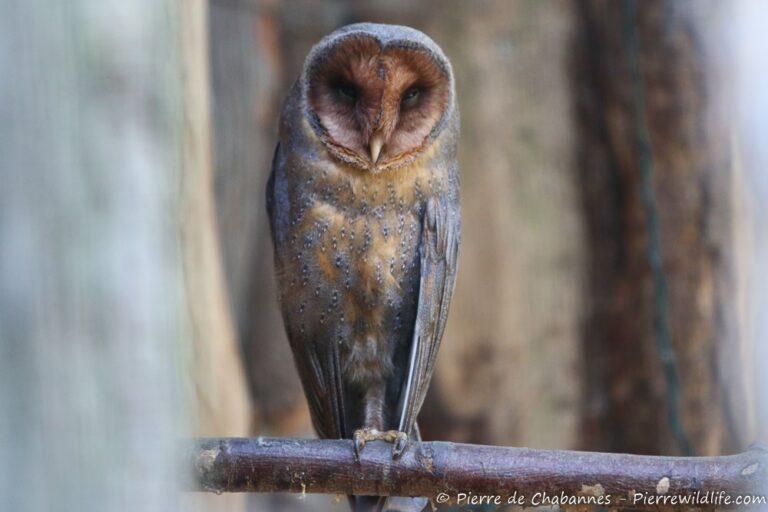
The facial disk typically appears pinkish-brown or vinaceous with a golden-brown rim.

São Tomé Barn Owl, captive individual with extensively gray plumage.  © Pierre de Chabannes

Some individuals have gray plumage nearly throughout, except for the facial disk.

São Tomé Barn Owl, captive individual with extensively gray plumage.  (August 2017.)  © Vision

Voice.  Little-studied, but generally similar to other barn owls.  Recorded calls include a frequently repeated screech that lasts about a second and can be relatively soft: Or shrill:

Notes

Monotypic species.  Traditionally classified as a subspecies of the Barn Owl (T. alba), but more recently treated as a subspecies of the Western Barn Owl (T. alba) by several taxonomic authorities.

Provisionally treated as a separate species here because both recent guidebooks to the owls of the world, König and Weick (2008) and Mikkola (2013), recognize it as such.

References

Aliabadian, M., N. Alaei-Kakhki, O. Mirshamsi, V. Nijman, and A. Roulin. 2016. Phylogeny, biogeography, and diversification of barn owls (Aves: Strigiformes). Biological Journal of the Linnean Society 119:904-918.

BirdLife International. 2019. Tyto alba (amended version of 2016 assessment). The IUCN Red List of Threatened Species 2019: e.T22688504A155542941. https://dx.doi.org/10.2305/IUCN.UK.2019-3.RLTS.T22688504A155542941.en. (Accessed December 6, 2023.)

eBird. 2023. eBird: An online database of bird distribution and abundance. Cornell Lab of Ornithology, Ithaca, N.Y. http://www.ebird.org. (Accessed December 6, 2023.)

iNaturalist. 2023. https://www.inaturalist.org/. (Accessed December 6, 2023.)

König, C., and F. Weick. 2008. Owls of the World (Second Edition). Yale University Press.

Mikkola, H. 2013. Owls of the World: A Photographic Guide (Second Edition). Firefly Books, London.

Xeno-Canto. 2023. Western Barn Owl – Tyto alba. https://xeno-canto.org/species/Tyto-alba. (Accessed December 6, 2023.)

]]>
https://birdfinding.info/sao-tome-barn-owl/feed/ 1
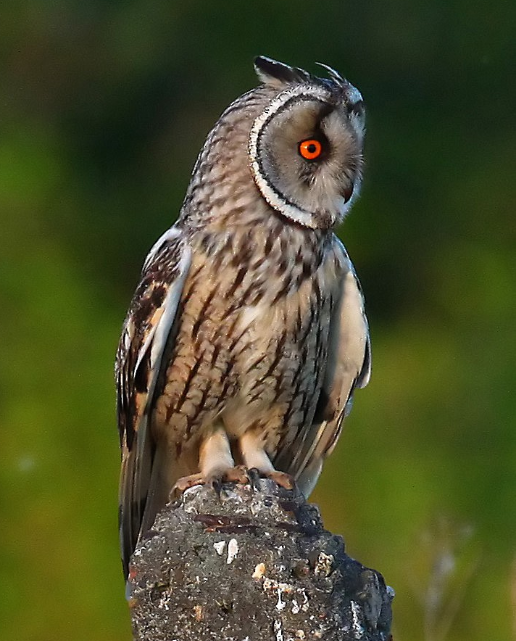
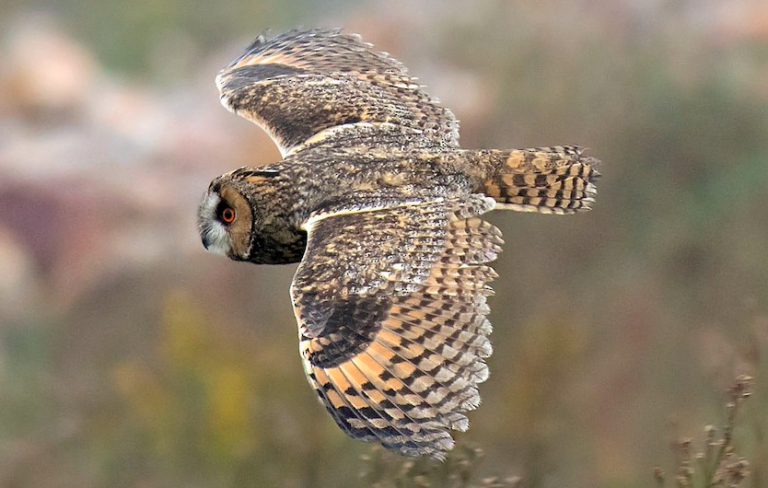
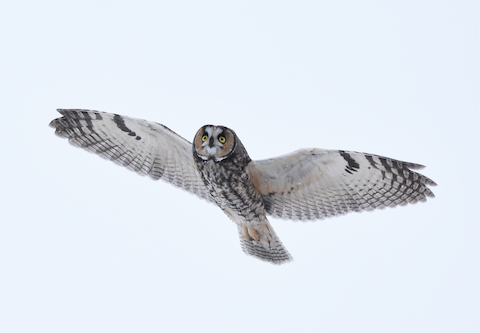
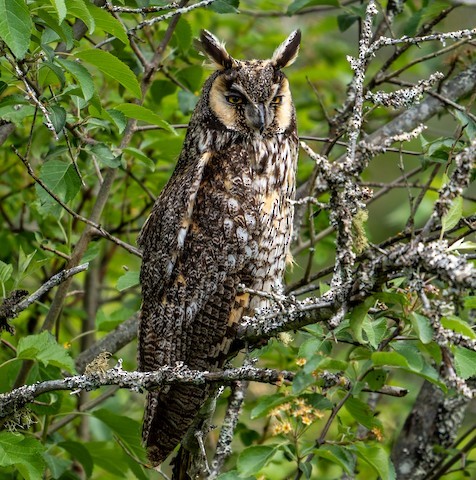
Long-eared Owl https://birdfinding.info/long-eared-owl/ https://birdfinding.info/long-eared-owl/#comments Thu, 30 Nov 2023 11:29:02 +0000 https://birdfinding.info/?p=136793

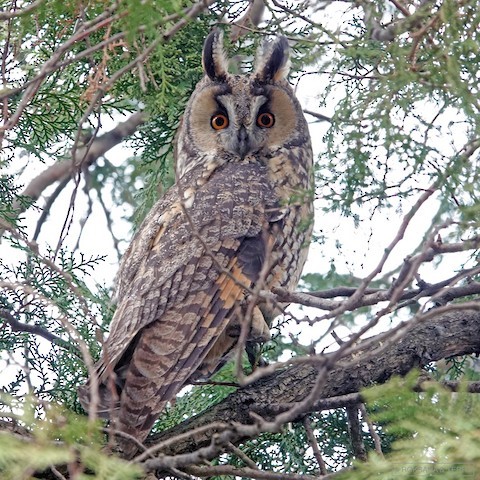
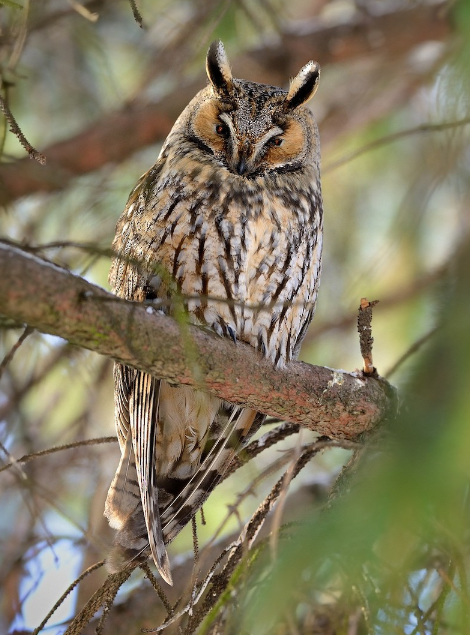
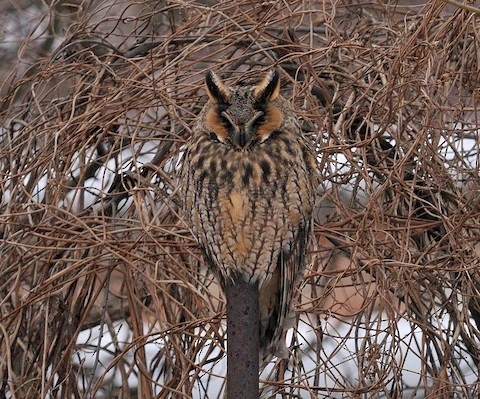
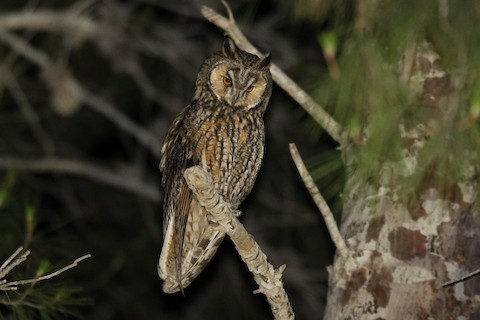
Birdfinding.info ⇒  Across both Eurasia and North America, the Long-eared Owl is widespread and numerous overall, but secretive and difficult to find except at winter roosts.  Both forms typically roost socially in dense stands of trees near open fields.  The “Eurasian” form is especially common in Serbia and neighboring countries, where many towns have traditional roosting sites with flocks that regularly number in the dozens, and occasionally in the hundreds.  Most winter roosting sites of the “American” form are kept secret due to concern for the impact of repeated disturbance.

Long-eared Owl

Asio otus

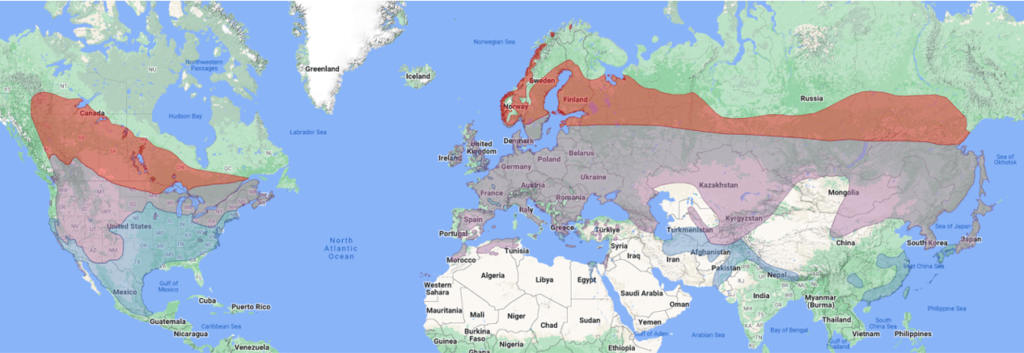
Temperate woodlands of Eurasia and North America.  Comprises two distinct forms which may be more appropriately classified as separate species: the “Eurasian Long-eared Owl” (otus) and the “American Long-eared Owl” (wilsonianus).

Approximate distribution of the Long-eared Owl.  © Xeno-Canto 2023

Breeding.  Nests in various kinds of woodlands and semi-open habitats, usually in dense forest or thickets that are near open meadows.

The Eurasian form breeds nearly throughout Europe, north to the treeline in Scandinavia and south to northern Morocco, Algeria, and Israel.  Also on the Azores (all except Flores), the Canary Islands (throughout), and many of the larger Mediterranean islands.

In Asia, it breeds in most of the taiga belt from northwestern Russia east to Yakutsk, and south mainly in mountains to western and northeastern Iran, northern Afghanistan, northern India (to Himachal Pradesh), and northern China.  Also on Sakhalin, Hokkaido, and northern Honshu.

The Canary Island population of Long-eared Owl is classified as a separate subspecies, A. o. canariensis.  (Costa Teguise, Lanzarote, Canary Islands, Spain; January 17, 2022.)  © Aitor Gil Guruceaga

The American form breeds over a large portion of Canada and the western and northeastern U.S.  In the west it breeds from the southern Yukon and Northwest Territories south through most of the western U.S. from the Rocky Mountains to the Pacific coast, and south to northern Mexico—where there are summer records from northern Baja California, Chihuahua, and Nuevo León.  In the east, it breeds from central Manitoba, northern Ontario, south-central Quebec, and the southern Maritimes south to Colorado, Nebraska, the northern Great Lakes, and in the northeastern U.S. south to West Virginia.

Nonbreeding.  Northerly breeding populations of Scandinavia and the taiga of Eurasia and Canada withdraw to milder climates for the winter, and most other populations move locally.  The favored habitat shifts away from forests toward semi-open land, including agricultural and urban areas.  Remarkably sociable on wintering grounds, typically roosting in flocks—usually from the single digits up to twenty or so, but roosts numbering in the hundreds have been reported, mainly in central Europe.

The Eurasian form winters from southern Scandinavia, western Russia, Kazakhstan, Mongolia, Heilongjiang, and Honshu south to the Mediterranean region, Kuwait, Rajasthan, the southern Himalayas, central China (south to Sichuan, Hubei, and Zhejiang), South Korea, and Kyushu; and irregularly south to Egypt, the U.A.E., southern Pakistan, Gujarat, southern China, Taiwan, and the Ryukyu Islands.

The American form’s winter range overlaps widely with its breeding range, but excludes most of Canada.  The northern edge extends from southern British Columbia east through Montana, South Dakota, and the Great Lakes to the St. Lawrence Valley of Quebec.  There are scattered winter records north to southeastern Alaska, the central Prairie Provinces, and Newfoundland.

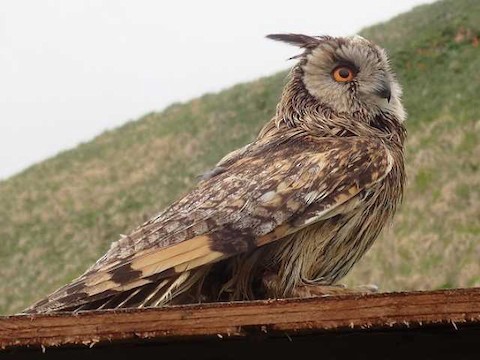
One of the two Alaskan records of “Eurasian Long-eared Owl”, A. o. otus.  (Buldir Island, Alaska; June 8, 2016.)  © Mackenzie Mudge

In the west, a small portion of the population moves south into Mexico, where roosting flocks have been found as far south as Durango and scattered individuals have been found recently south to Puerto Vallarta, Guadalajara, northern Michoacán, Mexico City, and southern Veracruz.

East of the Great Plains, it winters regularly south to the Ohio River Valley and Chesapeake Bay area, rarely south to Arkansas, Tennessee, and North Carolina, and exceptionally south to Florida.

Movements.  The Eurasian form is occasional as a spring and fall vagrant west to the Faeroes and Iceland.  Exceptional vagrants have been reported from Madeira, Western Sahara, southern Egypt, the Red Sea coast of Saudi Arabia, and Oman.  It has been recorded twice in western Alaska: once on a boat in the northern Bering Sea; and the other on Buldir Island (June 8, 2016).

The American form is occasional as a fall and winter vagrant offshore to Isla Guadalupe (west of Baja California) and Bermuda.  There are historical records south to Guerrero, Oaxaca, and Cuba.

Identification

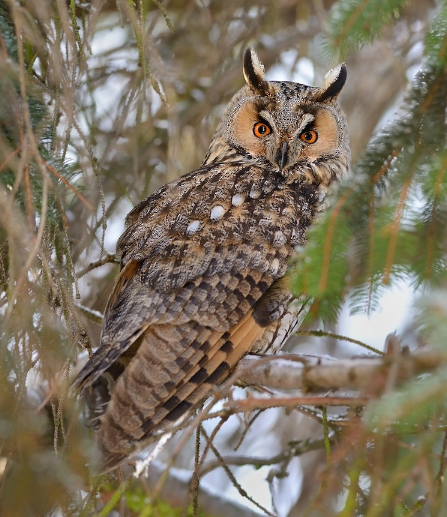
A medium-sized owl that usually appears proportionately thin, long-bodied, and long-winged.  Its prominent ear-tufts are close-set, directly above its eyes, and are often raised in alarm.  Mostly nocturnal, but sometimes active around dusk—the most northerly breeding populations are inevitably active during daylight hours in summer.

The “Eurasian” and “American” forms are similar in most respects, but are usually distinguishable based on their overall coloration and plumage patterns.  Their appropriate taxonomic status as distinct forms or possibly as separate species is uncertain.

Neither form has ever been recorded in the other form’s range, so identification by location is generally sufficient.  However, both forms are migratory and both have been recorded in Alaska and on remote North Atlantic islands, so they may overlap from time to time.

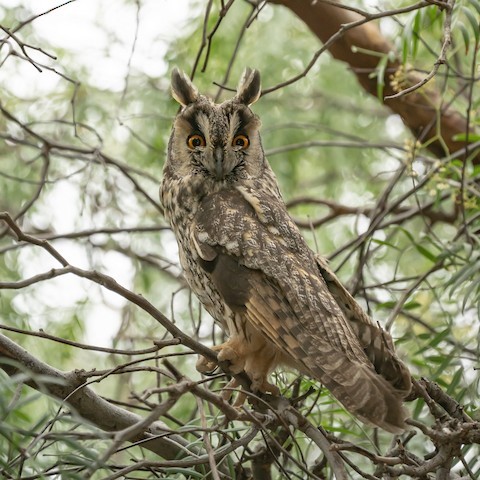
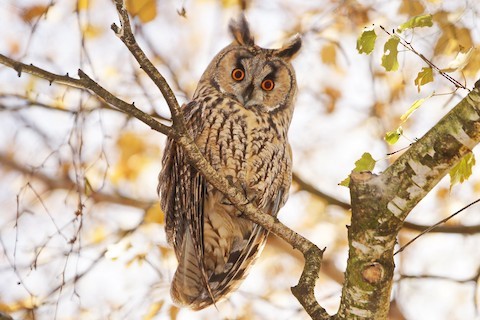
“Eurasian Long-eared Owl”, A. o. otus.  (Velké Bílovice, Jihomoravský Kraj, Czechia; January 20, 2018.)  © Pavel Štěpánek

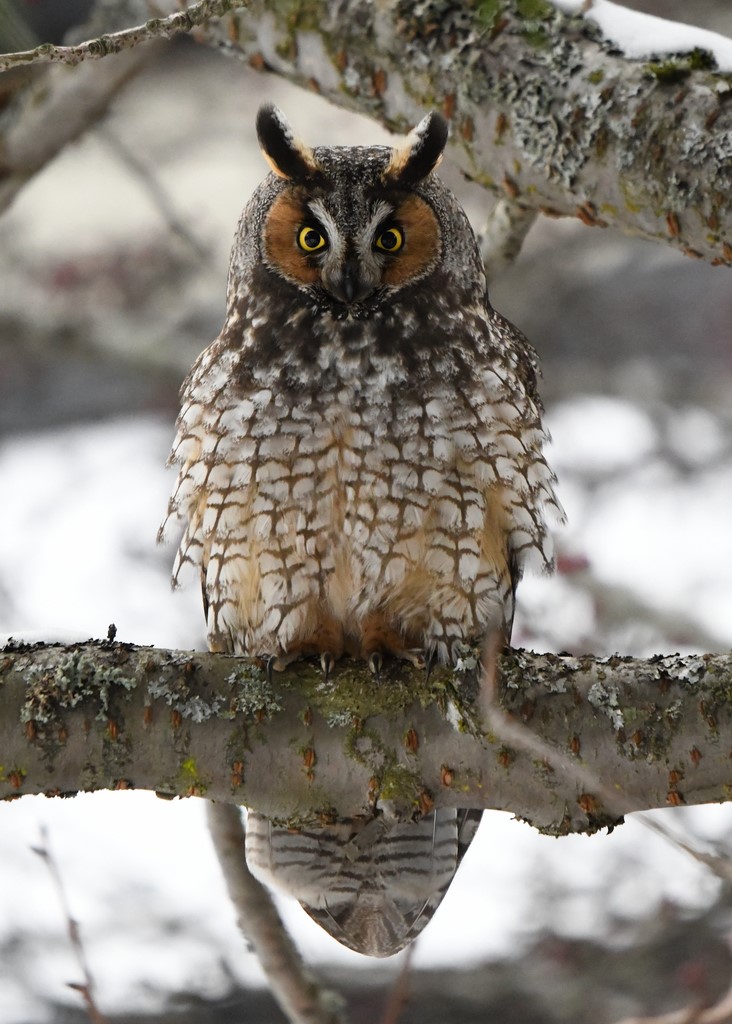
The most definitive difference is eye color.  The American form almost always shows pale- or bright-yellow irises, whereas the Eurasian form’s irises almost always appear orange—but can vary from yellow to red.

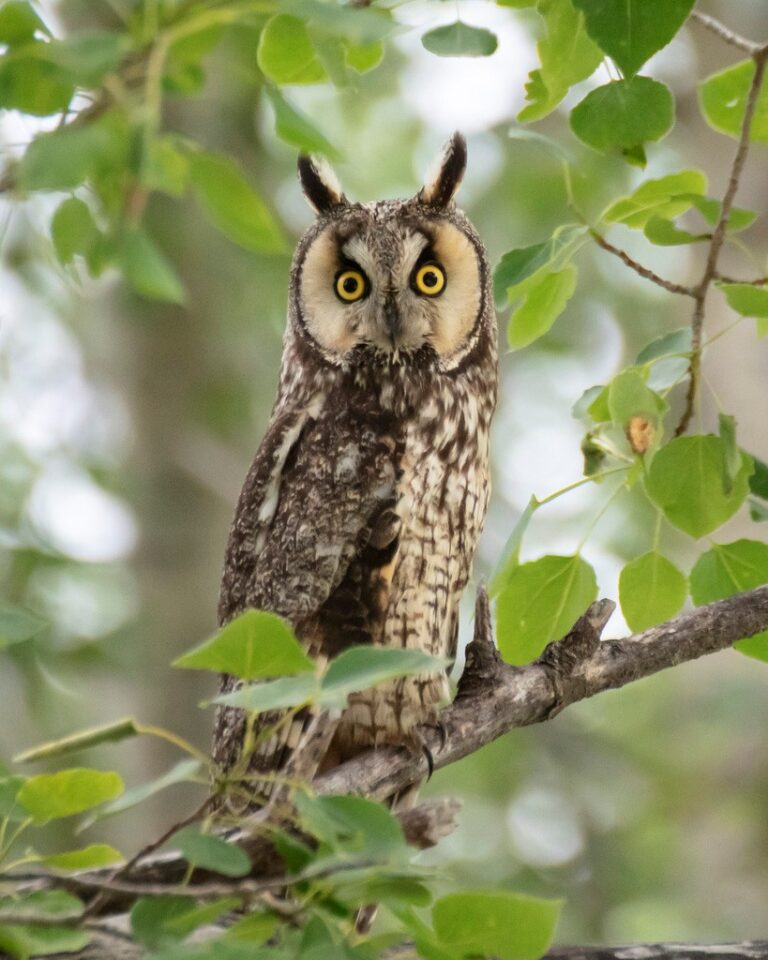
“American Long-eared Owl”, A. o. wilsonianus, showing a typically rusty facial disk and bright-yellow eyes.  (Arapahoe County, Colorado.)  © Dave Prentice

Their typical plumages also differ, most noticeably on the underparts.  Both forms have mostly brown, cryptically patterned upperparts.

The Eurasian form is typically paler, grayer, and more uniform overall, with less heavily marked underparts—the markings on the belly typically appear as streaks without strong cross-barring.

“Eurasian Long-eared Owl”, A. o. otus, showing typically streaked underparts with weak cross-barring.  (Novara, Italy; December 2, 2018.)  © Luigi Andena

“American Long-eared Owl”, A. o. wilsonianus, a boldly-patterned, richly-colored individual.  (Black Hawk County, Iowa.)  © Dean Hester

The American form is typically darker and more contrasty overall, usually with much more heavily marked underparts—the markings on the belly show strong, blackish streaks and cross-barring.

However, both forms are highly variable and the darkest Eurasian birds show coloration and markings that would be typical of the American form.  Likewise, pale American birds can show coloration typical of the Eurasian form, though usually with stronger cross-barring on the belly.

“Eurasian Long-eared Owl”, A. o. otus, a pale individual with a pale-gray facial disk.  (Maloyaroslavets, Kaluga Oblast, Russia; July 11, 2015.)  © Pavel Parkhaev

The Eurasian form’s facial disk is relatively pale, usually buffy or tan, but sometimes gray (or even whitish) and sometimes orangish—exceptionally rufous or chestnut.  The American form’s facial disk is usually rufous or chestnut, but sometimes buffy or grayish.

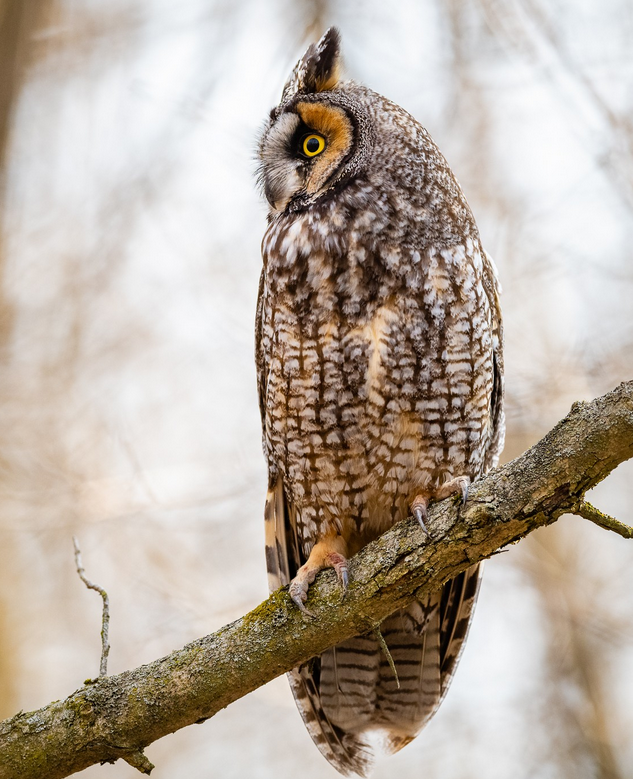
Facial appearance varies significantly depending on alertness and posture.  When encountered in daytime, it is typically seen in its resting posture, appearing tall and thin overall, with the facial disk narrowed and creased vertically and the ear-tufts raised vertically.

“Eurasian Long-eared Owl”, A. o. otus, an exceptionally dark individual with a rufous facial disk—much more typical of the American form—but note the orange eyes.  (Hazor’im Reservoir, HaZafon, Israel; August 9, 2023.)  © חיים ששון

“American Long-eared Owl”, A. o. tuftsi, showing a whitish facial disk, more typical of the Eurasian form—but note the pale-yellow eyes.  (Cariboo, British Columbia.)  © Leslie Harris Jr.

When alert and active, especially when hunting, it opens its facial disk to a more circular shape and raises feather rows around the rim—which presumably enhances its ability to locate prey by sound—often showing a bright-white border.  In this posture, the ear-tufts may either be raised or lowered.  (When the ear-tufts are lowered, confusion with the Short-eared Owl is sometimes possible.)

“Eurasian Long-eared Owl”, A. o. otus, with ear-tufts raised and facial disk narrowed.  (Vila Franca de Xira, Portugal; October 9, 2022.)  © Marcio Cachapela

“Eurasian Long-eared Owl”, A. o. otus, with ear-tufts lowered and facial disk open and alert, showing exceptionally vivid orange eyes.  (Michurinets Like, Moscow, Russia; May 24, 2011.)  © Vladimir Duryabin

When seen flight, it can appear remarkably similar to a Short-eared Owl.  The upperside of the wing appears mostly brown with darker bands and a prominent buffy patch in the primaries.

“Eurasian Long-eared Owl”, A. o. otus, dorsal view in flight, showing buffy patch at the base of the primaries.  (Puerto del Musel, Gijón, Asturias, Spain; October 31, 2016.)  © Daniel López-Velasco / Ornis Birding Expeditions

“American Long-eared Owl”, A. o. tuftsi, ventral view in flight.  (Walla Walla, Washington.)  © Christopher Lindsey

The underside of the wing is mostly pale with a prominent black crescent at the base of the primaries, and two or three distinct dark bars on the outer primaries.

Voice.  The male’s advertising song is a low single whoo—among the most archetypal owl calls—given at regular intervals of approximately 1 to 3 seconds:

The American form’s typical song is somewhat higher-pitched than the Eurasian’s, more emphatic, with a slight rise and fall in each hoot:

Sometimes builds in intensity:Sometimes the American’s hoots are weaker, less emphatic, and can be fairly similar to Eurasian:Sometimes they are much more strongly voiced:Females’ calls are more nasal and higher-pitched, variably spaced at longer intervals (about 5 to 20 seconds), and usually given in response to the male’s song:Sometimes resembling a kazoo:Alarm calls of the Eurasian form include various types of barks, often in short bursts, that can be harsh:Or sharp:Or raspy:Or mellow:Or nasal:Or high-pitched:Juvenile begging calls are shrill whistles:The typical alarm call of the American form is a bark, often in short bursts, and the juvenile’s begging call is a shrill whistle—both heard in the following recordings:(For a detailed review of the Eurasian form’s vocalizations, with more recordings and sonograms, see The Sound Approach: Long-eared Owl.)

Notes

Polytypic species consisting of four recognized subspecies that are divided into two distinct forms which may be more appropriate classified as separate species: the “Eurasian Long-eared Owl” (otus) and the “American Long-eared Owl” (wilsonianus).

More Images of the Long-eared Owl

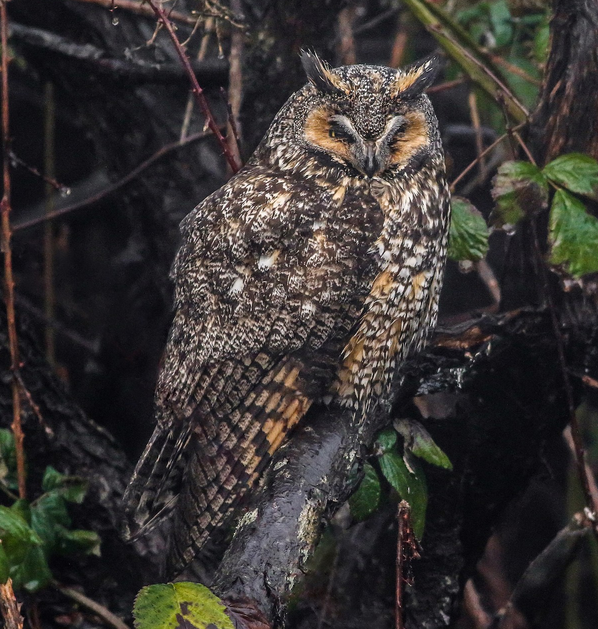
“American Long-eared Owl”, A. o. tuftsi, with atypically buffy facial disk, and showing cryptically patterned upperparts.  (Squamish, British Columbia; June 6, 2022.)  © Tiffany Brunke

“American Long-eared Owl”, A. o. tuftsi, appearing atypically robust—comparable to a Great Horned Owl—due to its hunched posture.  (Vancouver, British Columbia.)  © Joshua Glant

“American Long-eared Owl”, A. o. wilsonianus.  (Clanwilliam, Manitoba; July 10, 2022.)  © Karl Kroeker

“American Long-eared Owl”, A. o. wilsonianus, appearing relatively tall and thin due to its alert posture.  (Cuyahoga County, Ohio.)  © Toby Carlstrom

“American Long-eared Owl”, A. o. tuftsi.  (Cache County, Utah.)  © Ryan O’Donnell

“Eurasian Long-eared Owl”, A. o. otus.  (Opovo, Vojvodina, Serbia; November 25, 2018.)  © Roksana and Terry

“Eurasian Long-eared Owl”, A. o. otus, showing typically streaked underparts.  (Velké Bílovice, Jihomoravský Kraj, Czechia; January 20, 2018.)  © Pavel Štěpánek

“Eurasian Long-eared Owl”, A. o. otus, a relatively dark and reddish individual, with overall coloration and pattern more typical of the American form, A. o. wilsonianus.  (Drnholec, Jihomoravský Kraj, Czechia; February 6, 2010.)  © Tomáš Grim

“Eurasian Long-eared Owl”, A. o. otus, a relatively dark individual with substantial cross-barring on the underparts.  (Kibbutz Sde Boker, HaDarom, Israel; June 11, 2020.)  © Amit Goldstein

“Eurasian Long-eared Owl”, A. o. otus, showing typically streaked underparts.  (Freiburg im Breisgau, Baden-Württemberg, Germany; November 18, 2017.)  © Hieko Heerklotz

“American Long-eared Owl”, A. o. tuftsi, showing typically rusty facial disk and bright-yellow eyes.  (Saanich, British Columbia; December 2021.)  © Brian Starzomski

“American Long-eared Owl”, A. o. wilsonianus.  (Lambton, Ontario; April 7, 2021.)  © Roberta Buchanan

“American Long-eared Owl”, A. o. tuftsi, with its facial disk opened and ear-tufts partly flattened.  (Alameda County, California.)  © Aaron Maizlish

“American Long-eared Owl”, A. o. tuftsi, with its facial disk opened and ear-tufts partly flattened.  (San Francisco, California.)  © Matt Brady

“American Long-eared Owl”, A. o. wilsonianus.  (Steele County, Minnesota.)  © Brendan Lanpher

“Eurasian Long-eared Owl”, A. o. otus, showing pale underwing with a prominent black crescent at the base of the primaries, and three dark bars on the outer the primaries.  (Söderskär, Emäsalo, Uusimaa, Finland; May 3, 2020.)  © Matti Rekilä

References

Alderfer, J., and J.L. Dunn. 2021. National Geographic Complete Birds of North America (Third Edition). National Geographic Society, Washington, D.C.

BirdLife International. 2021. Asio otus. The IUCN Red List of Threatened Species 2021: e.T22689507A201150685. https://dx.doi.org/10.2305/IUCN.UK.2021-3.RLTS.T22689507A201150685.en. (Accessed October 17, 2023.)

Brazil, M. 2009. Birds of East Asia. Princeton University Press.

eBird. 2023. eBird: An online database of bird distribution and abundance. Cornell Lab of Ornithology, Ithaca, N.Y. http://www.ebird.org. (Accessed October 17, 2023.)

Garcia-del-Rey, E. 2011. Field Guide to the Birds of Macaronesia: Azores, Madeira, Canary Islands, Cape Verde. Lynx Editions, Barcelona.

Garcia-del-Rey, E. 2018. Birds of the Canary Islands. Christopher Helm, London.

Hollom, P.A.D., R.F. Porter, S. Christensen, and I. Willis. 1988. Birds of the Middle East and North Africa. T & AD Poyser, Calton, England.

Howell, S.N.G., and S. Webb. 1995. A Guide to the Birds of Mexico and Northern Central America. Oxford University Press.

iNaturalist. 2023. https://www.inaturalist.org/. (Accessed October 17, 2023.)

Kirwan, G.M., A. Levesque, M. Oberle, and C.J. Sharpe. 2019. Birds of the West Indies. Lynx Edicions, Barcelona.

König, C., and F. Weick. 2008. Owls of the World (Second Edition). Yale University Press.

Mikkola, H. 2012. Owls of the World: A Photographic Guide. Firefly Books, London.

Mullarney, K., L. Svensson, D. Zetterström, and P.J. Grant. 1999. Birds of Europe. Princeton University Press.

Owl Pages. 2023. Long-eared Owl ~ Asio otus. https://www.owlpages.com/owls/species.php?s=3550. (Accessed October 17, 2023.)

Salt, W.R., and J.R. Salt. 1976. The Birds of Alberta. Hurtig Publishers, Edmonton, Alberta.

Sibley, D.A. 2014. The Sibley Guide to Birds (Second Edition). Alfred A. Knopf. New York.

The Sound Approach. 2019. Long-eared Owl, Asio otus. https://soundapproach.co.uk/species/long-eared-owl/.

Xeno-Canto. 2023. Long-eared Owl – Asio otus. https://xeno-canto.org/species/Asio-otus. (Accessed October 17, 2023.)
]]>
https://birdfinding.info/long-eared-owl/feed/ 1
“American Long-eared Owl” https://birdfinding.info/american-long-eared-owl/ https://birdfinding.info/american-long-eared-owl/#comments Wed, 01 Nov 2023 15:43:42 +0000 https://birdfinding.info/?p=136343

Birdfinding.info ⇒  The North American form of the Long-eared Owl is thought to be fairly common in much of its range, but secretive and difficult to find—more so than most other North American owls, a trait that may be largely due to its status as a favored prey item of the numerous and widespread Great Horned Owl.  In the birdwatching community, most known sites are kept secret out of concern for the impact of repeated disturbance.  It is most readily found at winter roosts, which are often in dense stands of small conifers, including those that are planted in rows as windbreaks.  With knowledge of this preference, targeted searches can be an effective way to find this widely sought-after species.

“American Long-eared Owl”

Asio otus wilsonianus

Temperate woodlands of North America.

Approximate distribution of the “American Long-eared Owl”.  © Xeno-Canto 2023

Breeding.  Nests in coniferous and mixed woodlands, usually in dense forest or thickets that are near open meadows, over a large portion of Canada and the western and northeastern U.S., and very locally into northern Mexico.

The northern limit of its breeding range is not well-understood.  In western Canada it has been recorded nesting north to the southern Yukon and Northwest Territories (north to Fort Simpson); in central Canada north to central Manitoba, and northern Ontario; and in eastern Canada north to south-central Quebec, the Gaspé Peninsula, Prince Edward Island, and central Nova Scotia.

Southward, it breeds locally across most of the western U.S. from the Rocky Mountains to the Pacific coast and south to northern Mexico—where there are summer records from northern Baja California, Chihuahua, and Nuevo León.  East of the Rockies, it breeds across the northern tier of states south to Colorado, Nebraska, the northern Great Lakes, and in the northeastern U.S. south to West Virginia.

Nonbreeding.  In winter, favored habitats shift away from forests toward semi-open land, including agricultural areas and parks, where it typically roosts socially, in flocks that number from a few birds up to a few dozen.

The winter range overlaps widely with the breeding range, but excluding most of Canada.  The northern edge extends from southern British Columbia east through Montana, South Dakota, and the Great Lakes to the St. Lawrence Valley of Quebec.  There are a scattered winter records farther north to southeastern Alaska, the central Prairie Provinces, and Newfoundland.

In the west, a small portion of the population moves south into Mexico, where roosting flocks have been found as far south as Durango and scattered individuals have been found recently south to Puerto Vallarta, Guadalajara, northern Michoacán, Mexico City, and southern Veracruz.  There are historical records south to Guerrero and Oaxaca.  Vagrants have strayed offshore to Isla Guadalupe.

East of the Great Plains, it winters regularly south to the Ohio River Valley and Chesapeake Bay area, rarely south to Arkansas, Tennessee, and North Carolina, and exceptionally south to the Gulf Coast and Florida.  Occasional as a fall and winter vagrant to Bermuda.  There is a single historical record from Cuba in October 1932.

Identification

A medium-sized owl that usually appears proportionately thin, long-bodied, and long-winged.  Its prominent ear-tufts are close-set, directly above its eyes, and are often raised in alarm.  Mostly nocturnal, but sometimes active around dusk.

“American Long-eared Owl”, A. o. wilsonianus, showing a typically rusty facial disk and bright-yellow eyes.  (Arapahoe County, Colorado.)  © Dave Prentice

Closely resembles the “Eurasian Long-eared Owl”, although the two forms may be better regarded as separate species. 

The American form differs most definitively in almost always showing pale- or bright-yellow irises, whereas the Eurasian form’s irises almost always appear orange—but can vary from yellow to red.

“American Long-eared Owl”, A. o. tuftsi, appearing atypically robust—comparable to a Great Horned Owl—due to its hunched posture.  (Vancouver, British Columbia.)  © Joshua Glant

The American form’s facial disk is usually rufous or chestnut, but sometimes buffy or grayish.

“American Long-eared Owl”, A. o. tuftsi, showing typically rusty facial disk and bright-yellow eyes.  (Saanich, British Columbia; December 2021.)  © Brian Starzomski

“American Long-eared Owl”, A. o. tuftsi, showing a whitish facial disk, more typical of the Eurasian form—but note the pale-yellow eyes.  (Cariboo, British Columbia.)  © Leslie Harris Jr.

Their typical plumages also differ.  Both forms have mostly brown, cryptically patterned upperparts.  The Eurasian form is typically paler, grayer, and more uniform overall, with less heavily marked underparts—the markings on the belly typically appear as streaks without strong cross-barring.  However, both forms are highly variable and the darkest Eurasian birds show coloration and markings that would be typical of the American form.

“American Long-eared Owl”, A. o. tuftsi, with atypically buffy facial disk, and showing cryptically patterned upperparts.  (Squamish, British Columbia; June 6, 2022.)  © Tiffany Brunke

Facial appearance varies significantly depending on alertness and posture.  When encountered in daytime, it is typically seen in its resting posture, appearing tall and thin overall, with the facial disk narrowed and creased vertically and the ear-tufts raised vertically.

“American Long-eared Owl”, A. o. wilsonianus, appearing relatively tall and thin due to its alert posture.  (Cuyahoga County, Ohio.)  © Toby Carlstrom

When alert and active, especially when hunting, it opens its facial disk to a more circular shape and raises feather rows around the rim—which presumably enhances its ability to locate prey by sound—often showing a bright-white border.  In this posture, the ear-tufts may either be raised or lowered.  (When the ear-tufts are lowered, confusion with the Short-eared Owl is sometimes possible.)

“American Long-eared Owl”, A. o. tuftsi, with its facial disk opened and ear-tufts partly flattened.  (Alameda County, California.)  © Aaron Maizlish

“American Long-eared Owl”, A. o. tuftsi, with its facial disk opened and ear-tufts partly flattened.  (San Francisco, California.)  © Matt Brady

When seen in flight, it can appear remarkably similar to a Short-eared Owl.  The upperside of the wing appears mostly brown with darker bands, and typically shows buffy or rusty patches in the primaries.

“American Long-eared Owl”, A. o. wilsonianus.  (Steele County, Minnesota.)  © Brendan Lanpher

“American Long-eared Owl”, A. o. tuftsi, ventral view in flight.  (Walla Walla, Washington.)  © Christopher Lindsey

The underside of the wing is mostly pale with a prominent black crescent at the base of the primaries, and black-and-white barring on the outer primaries.

Voice.  The male’s typical advertising song is a low single whoo—among the most archetypal owl calls—given at regular intervals of approximately 1 to 3 seconds:Sometimes builds in intensity:

The American form’s typical song is somewhat higher-pitched than the Eurasian’s, more emphatic, with a slight rise and fall in each hoot.

Sometimes the American’s hoots are weaker, less emphatic, and can be fairly similar to Eurasian:Sometimes they are much more strongly voiced:Females’ calls are higher-pitched, variably spaced at longer intervals (about 5 to 20 seconds), and usually given in response to the male’s song:The typical alarm call is a bark, often in short bursts, and the juvenile’s begging call is a shrill whistle—both heard in the following recordings:

Notes

Polytypic form consisting of two recognized subspecies, collectively one of two distinct forms of the Long-eared Owl (A. otus).

More Images of the “American Long-eared Owl”

“American Long-eared Owl”, A. o. wilsonianus.  (Clanwilliam, Manitoba; July 10, 2022.)  © Karl Kroeker

“American Long-eared Owl”, A. o. tuftsi.  (Lambton, Ontario; April 7, 2021.)  © Roberta Buchanan

“American Long-eared Owl”, A. o. tuftsi.  (Cache County, Utah.)  © Ryan O’Donnell

References

Alderfer, J., and J.L. Dunn. 2021. National Geographic Complete Birds of North America (Third Edition). National Geographic Society, Washington, D.C.

BirdLife International. 2021. Asio otus. The IUCN Red List of Threatened Species 2021: e.T22689507A201150685. https://dx.doi.org/10.2305/IUCN.UK.2021-3.RLTS.T22689507A201150685.en. (Accessed October 17, 2023.)

eBird. 2023. eBird: An online database of bird distribution and abundance. Cornell Lab of Ornithology, Ithaca, N.Y. http://www.ebird.org. (Accessed October 17, 2023.)

Howell, S.N.G., and S. Webb. 1995. A Guide to the Birds of Mexico and Northern Central America. Oxford University Press.

iNaturalist. 2023. https://www.inaturalist.org/. (Accessed October 17, 2023.)

Kirwan, G.M., A. Levesque, M. Oberle, and C.J. Sharpe. 2019. Birds of the West Indies. Lynx Edicions, Barcelona.

König, C., and F. Weick. 2008. Owls of the World (Second Edition). Yale University Press.

Mikkola, H. 2012. Owls of the World: A Photographic Guide. Firefly Books, London.

Mullarney, K., L. Svensson, D. Zetterström, and P.J. Grant. 1999. Birds of Europe. Princeton University Press.

Owl Pages. 2023. Long-eared Owl ~ Asio otus. https://www.owlpages.com/owls/species.php?s=3550. (Accessed October 17, 2023.)

Salt, W.R., and J.R. Salt. 1976. The Birds of Alberta. Hurtig Publishers, Edmonton, Alberta.

Sibley, D.A. 2014. The Sibley Guide to Birds (Second Edition). Alfred A. Knopf. New York.

The Sound Approach. 2019. Long-eared Owl, Asio otus. https://soundapproach.co.uk/species/long-eared-owl/.

Xeno-Canto. 2023. Long-eared Owl – Asio otus. https://xeno-canto.org/species/Asio-otus. (Accessed October 17, 2023.)
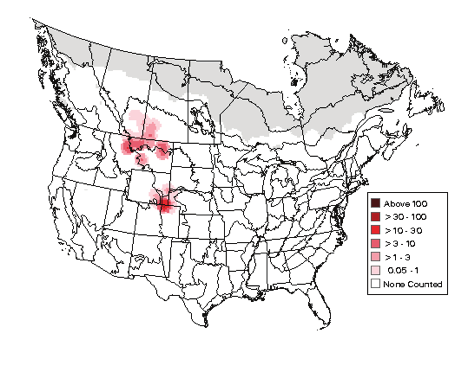
]]>
https://birdfinding.info/american-long-eared-owl/feed/ 2
“Eurasian Long-eared Owl” https://birdfinding.info/eurasian-long-eared-owl/ https://birdfinding.info/eurasian-long-eared-owl/#comments Fri, 13 Oct 2023 16:40:44 +0000 https://birdfinding.info/?p=136030

Birdfinding.info ⇒  The Eurasian form of the Long-eared Owl is numerous in Europe, but secretive and difficult to find except at winter roosts.  One famous roosting site is the town center of Kikinda in northern Serbia, where up to 750 have been reported.  Other Serbian towns that regularly host roosting flocks include Bašaid, Crna Bara, Melenci, Mokrin, Novi Kneževac, Opovo, Sremska Mitrovica, and Vršac.  Elsewhere, sites with perennial roosts include: in Austria, Apetlon Cemetery (Neuseidler See area); in Bulgaria, Kozloduy, Krushare, and North Park (Sofia); in Czechia, Drnholec, Ołomuniec, and Uhříněves (southeast of Prague); in France, Quartier Verbeau of Châlons-en-Champagne; in Germany, Anita-Berber-Park in Berlin, Attaching (Munich airport), Langenau, and Tönning; in Hungary, Apaj (near Budapest), three villages near Hortobágyi National Park (Balmazújváros, Karcag, and Kisujszállás); in Italy, Buronzo (near Milan); in Moldova, Cimișlia; in Portugal, Castro Verde (fire station area); in Romania, Ezerets and Shabla; and in Spain, the cemetery in Corella and Cerro de San Jorge in Huesca.

“Eurasian Long-eared Owl”

Asio otus otus

Temperate woodlands of Eurasia.

Approximate distribution of the “Eurasian Long-eared Owl”.  © Xeno-Canto 2023

Breeding.  Nests in various kinds of woodlands, usually in dense forest or thickets that are near open meadows, in a broad band across Eurasia.  Breeds nearly throughout Europe, north to the treeline in Scandinavia and south to northern Morocco, Algeria, and Israel.  Also on the Azores (all except Flores), the Canary Islands (throughout), and many of the larger Mediterranean islands.

In Asia, it breeds in most of the taiga belt from northwestern Russia east to Yakutsk, and south mainly in mountains to western and northeastern Iran, northern Afghanistan, northern India (to Himachal Pradesh), and northern China.  Also on Sakhalin, Hokkaido, and northern Honshu.

Nonbreeding.  Northerly breeding populations of Scandinavia and the taiga withdraw to milder climates for the winter, and most other populations move locally.  The favored habitat shifts away from forests toward semi-open land, including agricultural and urban areas.  Remarkably sociable on wintering grounds, typically roosting in flocks—usually from the single digits up to twenty or so, but roosts numbering in the hundreds have been reported, mainly in central Europe.

“Eurasian Long-eared Owl”, A. o. otus.  (Buldir Island, Alaska; June 8, 2016.)  © Mackenzie Mudge

In Europe, winters from southern Scandinavia and western Russia south to the Mediterranean region.  In Asia, winters north to Kazakhstan, Mongolia, Heilongjiang, and Honshu, and regularly south to Kuwait, Rajasthan, the southern Himalayas, central China (south to Sichuan, Hubei, and Zhejiang), South Korea, and Kyushu; and irregularly south to Egypt, the U.A.E., southern Pakistan, Gujarat, southern China, Taiwan, and the Ryukyu Islands.

Movements.  Occasional as a spring and fall vagrant west to the Faeroes and Iceland.  Exceptional vagrants have been reported from Madeira, Western Sahara, southern Egypt, the Red Sea coast of Saudi Arabia, and Oman.  Recorded twice in western Alaska: once on a boat in the northern Bering Sea; and the other on Buldir Island (June 8, 2016).

Identification

A medium-sized owl that usually appears proportionately thin, long-bodied, and long-winged.  Its prominent ear-tufts are close-set, directly above its eyes, and are often raised in alarm.  Mostly nocturnal, but sometimes active around dusk—and northern breeding populations are inevitably active during daylight hours.

Closely resembles the “American Long-eared Owl”, although the two forms may be better regarded as separate species. 

“Eurasian Long-eared Owl”, A. o. otus, typical plumage, showing vivid orange eyes.  (Velké Bílovice, Jihomoravský Kraj, Czechia; January 20, 2018.)  © Pavel Štěpánek

The Eurasian form differs most definitively in almost always showing orange irises, whereas the American form’s irises almost always appear bright-yellow.

“Eurasian Long-eared Owl”, A. o. canariensis, showing relatively pale, washed-out pattern on the upperparts.  (Costa Teguise, Lanzarote, Canary Islands, Spain; January 17, 2022.)  © Aitor Gil Guruceaga

Their typical plumages also differ.  Both forms have mostly brown, cryptically patterned upperparts.  The Eurasian form is typically paler, grayer, and more uniform overall, with less heavily marked underparts—the markings on the belly typically appear as streaks without strong cross-barring.  However, both forms are highly variable and the darkest Eurasian birds show coloration and markings that would be typical of the American form.

“Eurasian Long-eared Owl”, A. o. otus, showing typically streaked underparts.  (Freiburg im Breisgau, Baden-Württemberg, Germany; November 18, 2017.)  © Hieko Heerklotz

“Eurasian Long-eared Owl”, A. o. otus, a relatively dark individual with substantial cross-barring on the underparts.  (Kibbutz Sde Boker, HaDarom, Israel; June 11, 2020.)  © Amit Goldstein

“Eurasian Long-eared Owl”, A. o. otus, a pale individual with a pale-gray facial disk.  (Maloyaroslavets, Kaluga Oblast, Russia; July 11, 2015.)  © Pavel Parkhaev

The Eurasian form’s facial disk is relatively pale, usually buffy or tan, but sometimes gray (or even whitish) and sometimes orangish—exceptionally rufous or chestnut.

“Eurasian Long-eared Owl”, A. o. otus, an exceptionally dark individual with a rufous facial disk—much more typical of the American form, A. o. wilsonianus.  (Hazor’im Reservoir, HaZafon, Israel; August 9, 2023.)  © חיים ששון

Facial appearance varies significantly depending on alertness and posture.  When encountered in daytime, it is typically seen in its resting posture, appearing tall and thin overall, with the facial disk narrowed and creased vertically and the ear-tufts raised vertically.

“Eurasian Long-eared Owl”, A. o. otus, with ear-tufts raised and facial disk narrowed.  (Vila Franca de Xira, Portugal; October 9, 2022.)  © Marcio Cachapela

When alert and active, especially when hunting, it opens its facial disk to a more circular shape and raises feather rows around the rim—which presumably enhances its ability to locate prey by sound—often showing a bright-white border.  In this posture, the ear-tufts may either be raised or lowered.  (When the ear-tufts are lowered, confusion with the Short-eared Owl is sometimes possible.)

“Eurasian Long-eared Owl”, A. o. otus, with ear-tufts lowered and facial disk open and alert, showing exceptionally vivid orange eyes.  (Michurinets Like, Moscow, Russia; May 24, 2011.)  © Vladimir Duryabin

When seen flight, it can appear remarkably similar to a Short-eared Owl.  The upperside of the wing appears mostly brown with darker bands and a prominent buffy patch in the primaries.

“Eurasian Long-eared Owl”, A. o. otus, dorsal view in flight, showing buffy patch at the base of the primaries.  (Puerto del Musel, Gijón, Asturias, Spain; October 31, 2016.)  © Daniel López-Velasco / Ornis Birding Expeditions

“Eurasian Long-eared Owl”, A. o. otus, showing pale underwing with a prominent black crescent at the base of the primaries, and three dark bars on the outer the primaries.  (Söderskär, Emäsalo, Uusimaa, Finland; May 3, 2020.)  © Matti Rekilä

The underside of the wing is mostly pale with a prominent black crescent at the base of the primaries, and two or three distinct dark bars on the outer primaries.

Voice.  The male’s advertising song is a low single whoo—among the most archetypal owl calls—given at regular intervals of approximately 1.5 to 3 seconds:The Eurasian form’s typical song is lower, mellower, and more even-pitched than the American’s.

Females’ calls are more nasal and higher-pitched:
Sometimes resembling a kazoo(For a detailed review with more recordings and sonograms, see The Sound Approach: Long-eared Owl.)

Notes

Polytypic form consisting of two recognized subspecies, collectively one of two distinct forms of the Long-eared Owl (A. otus).

More Images of the “Eurasian Long-eared Owl”

“Eurasian Long-eared Owl”, A. o. otus.  (Novara, Italy; December 2, 2018.)  © Luigi Andena

“Eurasian Long-eared Owl”, A. o. otus, a relatively dark and reddish individual, with overall coloration and pattern more typical of the American form, A. o. wilsonianus.  (Drnholec, Jihomoravský Kraj, Czechia; February 6, 2010.)  © Tomáš Grim

“Eurasian Long-eared Owl”, A. o. otus, showing typically streaked underparts.  (Velké Bílovice, Jihomoravský Kraj, Czechia; January 20, 2018.)  © Pavel Štěpánek

“Eurasian Long-eared Owl”, A. o. otus.  (Opovo, Vojvodina, Serbia; November 25, 2018.)  © Roksana and Terry

References

BirdLife International. 2021. Asio otus. The IUCN Red List of Threatened Species 2021: e.T22689507A201150685. https://dx.doi.org/10.2305/IUCN.UK.2021-3.RLTS.T22689507A201150685.en. (Accessed October 17, 2023.)

Brazil, M. 2009. Birds of East Asia. Princeton University Press.

eBird. 2023. eBird: An online database of bird distribution and abundance. Cornell Lab of Ornithology, Ithaca, N.Y. http://www.ebird.org. (Accessed October 17, 2023.)

Garcia-del-Rey, E. 2011. Field Guide to the Birds of Macaronesia: Azores, Madeira, Canary Islands, Cape Verde. Lynx Editions, Barcelona.

Garcia-del-Rey, E. 2018. Birds of the Canary Islands. Christopher Helm, London.

Hollom, P.A.D., R.F. Porter, S. Christensen, and I. Willis. 1988. Birds of the Middle East and North Africa. T & AD Poyser, Calton, England.

iNaturalist. 2023. https://www.inaturalist.org/. (Accessed October 17, 2023.)

König, C., and F. Weick. 2008. Owls of the World (Second Edition). Yale University Press.

Mikkola, H. 2012. Owls of the World: A Photographic Guide. Firefly Books, London.

Mullarney, K., L. Svensson, D. Zetterström, and P.J. Grant. 1999. Birds of Europe. Princeton University Press.

Owl Pages. 2023. Long-eared Owl ~ Asio otus. https://www.owlpages.com/owls/species.php?s=3550. (Accessed October 17, 2023.)

The Sound Approach. 2019. Long-eared Owl, Asio otus. https://soundapproach.co.uk/species/long-eared-owl/.

Xeno-Canto. 2023. Long-eared Owl – Asio otus. https://xeno-canto.org/species/Asio-otus. (Accessed October 17, 2023.)

]]>
https://birdfinding.info/eurasian-long-eared-owl/feed/ 1